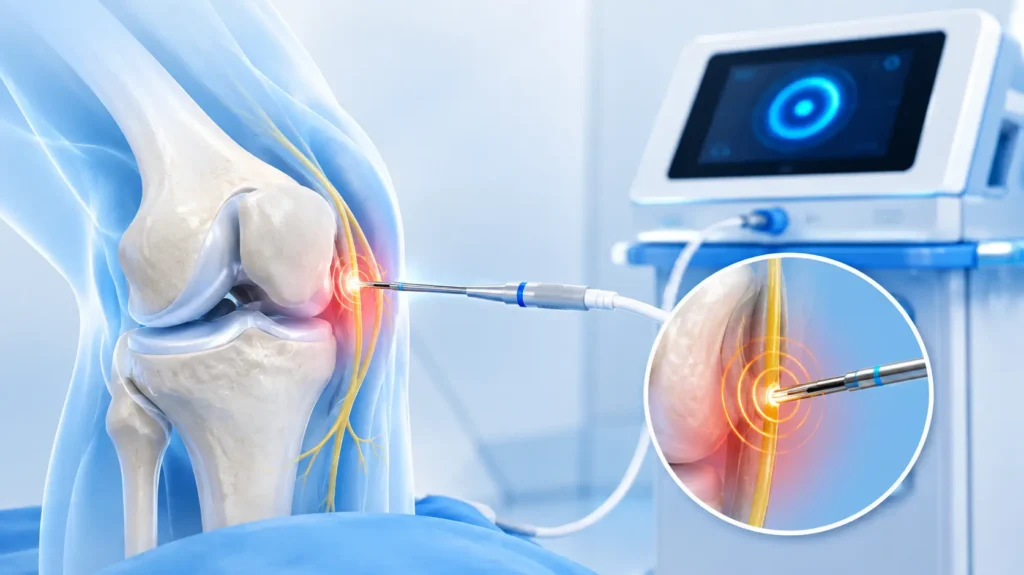
Genicular Nerve Radiofrequency Ablation (RFA) for Knee Osteoarthritis Pain
Genicular Nerve Radiofrequency Ablation (RFA) is a pain management procedure that utilizes thermal energy from radiofrequency waves delivered through a specialized needle tip to interrupt or ablate pain signal transmission from the nerves surrounding the knee joint (Genicular nerves), thereby reducing pain perception in the brain.
Currently, there is substantial empirical evidence and high-quality research supporting that Genicular Nerve RFA significantly reduces pain and improves knee joint functional capacity in the medium and long term, providing substantially longer-lasting results compared to intra-articular steroid injections.
Precautions and Scope of Treatment: This procedure aims solely to “reduce pain and improve quality of life.” It does not reverse articular cartilage degeneration, generate new cartilage, nor does it alter the structure or correct knee deformities. Therefore, this method is not a substitute for Total Knee Arthroplasty (TKA) in patients with clear structural indications who require anatomical correction.
Q&A: Indications and Patient Selection
Who is a suitable candidate for Genicular Nerve RFA treatment?
This procedure is suitable for patients experiencing chronic knee pain that impacts their daily activities, particularly the following groups:
- Patients who have undergone pharmacological treatment, physical therapy, or intra-articular injections without achieving adequate symptom relief.
- Patients with knee osteoarthritis who are not yet ready or do not wish to undergo major surgery at the time.
- Patients who are too young, making them unsuitable candidates for Total Knee Arthroplasty due to the limited lifespan of the prosthesis.
- Elderly patients or those with multiple comorbidities who are at an unacceptably high risk for major surgery and general anesthesia.
- Certain patients who continue to experience persistent knee pain even after undergoing Total Knee Arthroplasty.
- Patients seeking pain reduction to improve their ability to walk, exercise, or perform daily activities.
Is a Diagnostic Block necessary prior to performing RFA?
Historically, pain management physicians routinely performed a Genicular Nerve Block with local anesthetics to select patients and predict procedural success prior to the actual ablation. Currently, however, there is no definitive clinical consensus that every patient strictly requires a prior diagnostic block. In patients with clear pathology, physicians may consider proceeding directly to RFA. In cases presenting with complex symptoms, multi-system pain, or unclear etiologies, a Diagnostic Block remains highly valuable for collaborative treatment planning.
Comparison of Radiofrequency Technologies (3 Main Modalities Currently Available)
| Radiofrequency Technology PDF | Mechanism and Therapeutic Efficacy PDF | Duration of Pain Relief PDF |
| Conventional RF (Traditional Modality) | – The most widely used method with the most extensive supporting research database. – Capable of reducing pain by approximately 50-70% in appropriately selected patients. | Expected duration of relief is approximately 6-12 months |
| Cooled RF (Cooling System) | – US-FDA approved for the treatment of knee osteoarthritis pain. – Features a water cooling system around the needle tip, allowing for energy delivery that creates a larger lesion, providing better coverage of the nerve branches. – Capable of reducing pain by up to 60-80%. | Expected duration of relief is approximately 6-12 months, or longer in some cases |
| Bipolar RF (Dual Needle) | – Utilizes 2 RF needles working in tandem to create a large, continuous lesion between the needles. – Efficacy is comparable to Cooled RF, capable of reducing pain by approximately 50-70%. | Expected duration of relief is approximately 6-12 months |
How does the RFA procedure differ from intra-articular steroid injections?
- Intra-articular Steroid Injection: Focuses directly on reducing inflammation within the knee joint. Provides rapid pain relief, but with a short duration of action, typically lasting only 1-3 months.
- Genicular Nerve RFA: Targets the interruption of pain signals at the sensory nerves surrounding the knee joint. The therapeutic effect is longer-lasting, averaging 6-12 months, and provides clearly superior results compared to steroids in the medium and long term. However, over time, the nerves can regenerate and resume transmitting pain signals. If the patient has previously responded well, the RFA procedure can be safely repeated.
Which patient groups are contraindicated for Genicular Nerve RFA?
- Patients with chronic or acute skin infections at the proposed needle insertion site.
- Patients with abnormal bleeding disorders or those who cannot safely discontinue anticoagulants/antiplatelet medications.
- Patients whose primary source of pain is not the knee joint itself, such as referred pain from Lumbar Radiculopathy or other mimicking conditions.
- Patients with severe knee deformities or clear, severe knee instability.
- Patients with absolute surgical indications who desire structural correction via Total Knee Arthroplasty.
Procedural Details
- Procedure Type: This is an Outpatient Procedure requiring no hospital admission. Patients can return home on the same day following a recovery period.
- Setting and Guidance: Performed in an operating room or specialized procedure room, utilizing Fluoroscopy guidance or ultrasound to precisely target the nerves.
- Anesthesia and Duration: Utilizes local anesthesia in conjunction with intravenous sedation (IV Sedation). The procedure takes approximately 30-45 minutes. Bilateral procedures can be considered in a single session if the patient presents with bilateral symptoms. Following the procedure, most individuals retain the ability to walk normally.
- Preparation Precautions: If IV Sedation is administered or if anticoagulants need to be withheld, the patient must strictly adhere to fasting guidelines (NPO) and follow the physician’s instructions rigorously.
Post-Procedural Care and Complications
Potential Post-Procedural Symptoms
During the first 1-7 days, some patients may experience localized soreness, tightness, or a temporary increase in pain at the needle insertion site. This is a normal physiological reaction and will gradually resolve spontaneously. The procedure will begin to demonstrate its full efficacy in reducing knee pain within 2-6 weeks post-procedure.
Post-Procedure Guidelines
- Rest on the first day following the procedure. Avoid strenuous exercise or heavy lifting for the initial 2-3 days.
- Patients may walk and perform general daily activities as usual. Maintain adequate hydration and continue prescribed medications as directed by the physician.
If soreness occurs at the needle site, apply cold compresses during the first 24-48 hours.
Potential Complications (Very High Safety Profile)
Bruising, subcutaneous bleeding, or temporary numbness/tingling around the knee may occur. Severe infections or abnormal bleeding are exceedingly rare.
Warning signs requiring immediate medical attention prior to the scheduled follow-up: High fever, knee swelling, erythema, localized heat, purulent discharge from the needle puncture site, persistent and severe abnormal pain, uncontrolled bleeding, or sudden onset of lower extremity weakness/gait disturbances not previously present.
References
Quazi M, Madrid R, Thiyagarajan S, Abboud P, Kanjanapanang N, Shilling M, Sen H, Cooper AN, Conger AM, Lin P, et al. Genicular nerve radiofrequency ablation for the treatment of chronic knee pain: a systematic review with Bayesian network meta-analysis. Pain Medicine. 2026;27(6):635-648. doi:10.1093/pm/pnaf181.
Chou SH, Shen PC, Lu CC, Liu ZM, Tien YC, Huang PJ, Chou CM, Shih CL. Comparison of efficacy among three radiofrequency ablation techniques for treating knee osteoarthritis: a systematic review and meta-analysis. International Journal of Environmental Research and Public Health. 2021;18(14):7424. doi:10.3390/ijerph18147424.
Anombem OM, Oliver JE, Kilmer J, Tompkins RB, Ferrer C. Comparing the effectiveness of radiofrequency ablation and intra-articular steroid injections in the management of knee osteoarthritis: a systematic review. Cureus. 2025;17:e462184.
Barreto RB, Barreto AJ, Nascimento ALM, Carvalho DMB, Queiroz B. Efficacy and safety of genicular nerve ablation techniques for knee osteoarthritis: a systematic review and meta-analysis of sham-controlled randomized trials. Pain Medicine. 2025. doi:10.1093/pm/pnaf140.
Shanthanna H, Khaled M, Rosenblood D, Dhillon A. Outcome and predictors of knee radiofrequency ablation for chronic pain relief: a retrospective cohort study. Indian Journal of Anaesthesia. 2025;69(9):949-952. doi:10.4103/ija.ija_448_25.
Raikwar S, Kaushal RP, Jain P, Soni S, Singh J. Effectiveness of the cooled radiofrequency ablation of genicular nerves in patients with chronic knee pain. International Journal of Current Pharmaceutical Review and Research. 2025;17(2):829-835.
Vanneste T, Belba A, van Kuijk S, Kimman M, Bellemans J, Bonhomme V, Sommer M, Emans P, Vankrunkelsven P, Tartaglia K, Van Zundert J. Comparison of conventional and cooled radiofrequency treatment of the genicular nerves versus sham procedure for patients with chronic knee pain: protocol for a multicentre, double-blind, randomised controlled trial (COGENIUS). BMJ Open. 2023;13:e073949. doi:10.1136/bmjopen-2023-073949.
Chen AF, Khalouf F, Zora K, DePalma M, Kohan L, Guirguis M, Beall D. Cooled radiofrequency ablation compared with a single hyaluronic acid injection for chronic knee osteoarthritis pain: a multicenter randomized clinical trial. Journal of Bone and Joint Surgery American. 2020;102(17):1501-1510.
McCormick ZL, Korn M, Reddy R, et al. Randomized prospective trial of prognostic genicular nerve blocks to determine the predictive value for genicular nerve radiofrequency ablation. Pain Medicine. 2018.