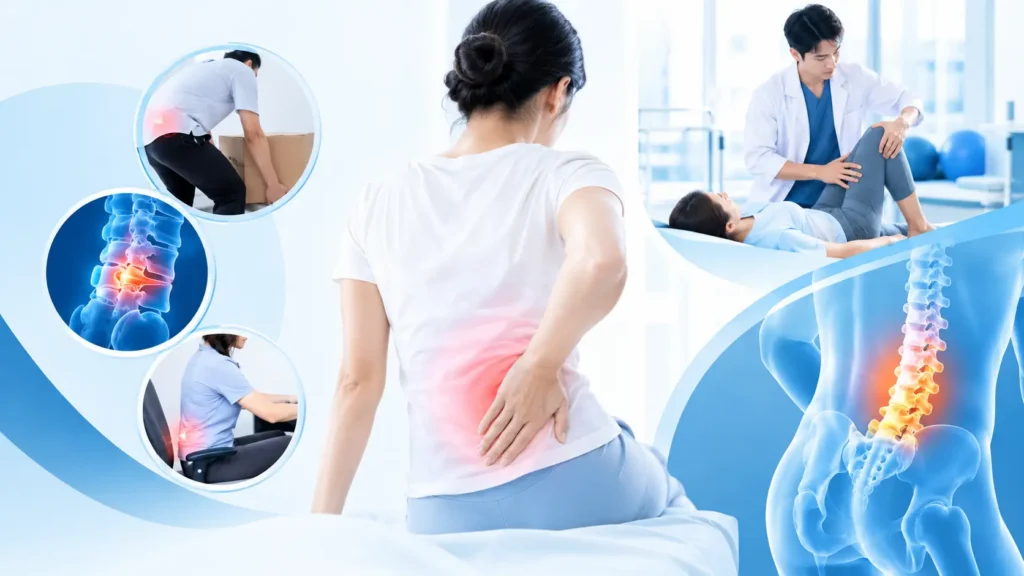
Low Back Pain: Etiology, Diagnosis, and Contemporary Management
Low Back Pain: Etiology, Diagnosis, and Contemporary Management
“Doctor, I’ve had MRIs done at three different hospitals, but each doctor gives me a different interpretation.” This is one of the most common dilemmas experienced by patients with low back pain (Low Back Pain). Clinically, low back pain is not a single disease, but a syndrome arising from a multitude of interwoven etiologies. In a significant number of patients, the true origin of pain does not align with the prominent findings on radiological imaging or MRI alone.
Currently, low back pain is a leading global cause of diminished quality of life and lost work productivity. The encouraging news is that the vast majority of patients can achieve recovery without surgical intervention, provided they receive an accurate differential diagnosis and treatment tailored directly to the underlying pathophysiology.
Q&A: Differences Between Acute and Chronic Low Back Pain
Acute Low Back Pain
- Definition: Back pain lasting for a duration of no more than 12 weeks.
- Primary Etiology: Frequently caused by muscle, ligament, and soft tissue injury around the spinal column (Muscle and soft tissue injury) resulting from heavy lifting, athletic activities, prolonged static postures, or awkward twisting movements.
- Management Approach: The majority of cases improve spontaneously within 6–8 weeks. Modern clinical guidelines do not recommend prolonged bed rest as practiced in the past. Robust evidence clearly demonstrates that early mobilization and returning to normal daily activities as tolerated yield significantly better clinical recovery outcomes.
Chronic Low Back Pain
- Definition: Pain persisting continuously for longer than 12 weeks.
- Primary Etiology: Involves complex disease mechanisms extending far beyond mere muscular involvement. The cornerstone of management in this patient cohort is not questioning what imaging reveals, but actively hunting down the “true Pain Generator.”
Classification of Low Back Pain (5 Core Categories)
- Spondylogenic Back Pain: The most frequently encountered category in pain clinics, encompassing:
– Muscle strain and Ligament sprain
– Disc degeneration or Disc herniation
– Discogenic pain
– Facet Joint Pain and Sacroiliac Joint Pain
– Vertebrogenic pain
– Lumbar Spinal Stenosis or osteoporotic vertebral compression fractures - Viscerogenic Back Pain: Back pain originating from visceral pathology within the abdominal or pelvic cavities, such as nephrolithiasis, pyelonephritis, pancreatitis, gynecological disorders, or bowel pathologies.
- Vasculogenic Back Pain: Conditions such as Abdominal Aortic Aneurysm (AAA) or Aortic Dissection. Although less common, these represent critical, life-threatening emergencies.
- Neurogenic Back Pain: Resulting from peripheral nerve entrapment or inflammation, spinal cord tumors, or nerve sheath tumors.
- Nociplastic Pain: Arising from central nervous system processing abnormalities, wherein central sensitization renders the nervous system hypersensitive to pain, causing pain persistence long after peripheral anatomical triggers have diminished or resolved.
Red Flag Symptoms
If these symptoms accompany back pain, immediate medical evaluation is mandatory to rule out infection, malignancy, fracture, or critical neural compression: fever, unexplained weight loss, prior history of malignancy, severe night pain, major physical trauma, rapidly progressive lower extremity weakness, saddle anesthesia (numbness in the perineal/genital region), or bowel/bladder incontinence indicative of Cauda equina syndrome.
Q&A: Limitations of MRI and the Physical Therapy Cycle
Does a Normal or Abnormal MRI Tell the Whole Story?
MRI does not provide all the answers. In clinical practice, an MRI visualizes only “structural or anatomical abnormalities” and does not serve as an indicator of whether a degenerated structure is the actual pain generator.
Statistical evidence indicates that a significant proportion of healthy adults aged 50–60 years exhibit disc degeneration, facet joint arthrosis, or bone spurs on routine MRI scans despite never experiencing back pain throughout their lives. These degenerative findings represent natural aging changes comparable to facial wrinkles or gray hair. Consequently, pain physicians base their therapeutic approach on clinical presentation rather than imaging findings alone.
Why Does Physical Therapy Provide Temporary Relief, Only for Pain to Return Upon Cessation?
This occurs because the “true Pain Generator” remains unaddressed. When deep structures such as the facet joints, sacroiliac joints, or intervertebral discs develop pathological lesions and transmit nociceptive signals, the body responds automatically by inducing severe paraspinal muscle spasm to restrict movement, functioning as a natural internal splint.
Therefore, the muscular tension experienced by patients is typically a secondary consequence rather than the primary root cause. Physical therapy and massage modalities effectively alleviate muscle spasm in the short term, but pain promptly recurs upon cessation as long as the deep-seated pain generator remains inflamed.
Specialized Interventional Management and Diagnostic Workup
When initial conservative management (NSAIDs, activity modification to avoid heavy lifting, weight management, smoking cessation, and consistent physical therapy for 4–6 weeks) fails to control symptoms, referral to a pain specialist for Interventional Pain Management is indicated:
- Diagnostic Block: In cases where MRI reveals multiple levels of degeneration that confound clinical correlation, the physician utilizes precise, small-volume local anesthetic injections to target suspect structures (e.g., Medial Branch Block, Facet block, or SI joint block), functioning as a “temporary off-switch.” If pain relief exceeds 75–80%, it confirms the precise pathological generator for subsequent treatment planning.
- Epidural Steroid Injection (ESI): The injection of anti-inflammatory corticosteroids around the nerve roots, indicated for patients with disc herniation or spinal stenosis presenting with radicular pain radiating down the lower extremities.
- Radiofrequency Ablation (RFA): The application of high-frequency radio waves to thermally ablate and disrupt pain signals from joint-innervating nerves (medial branches). Highly suited for patients with Facet joint syndrome, providing prolonged analgesia lasting 8–12 months.
- Epidural Adhesiolysis: A targeted procedure to lyse dense perineural scar tissue within the epidural space, indicated for patients suffering from persistent spinal pain following previous back surgery (PSPS Type 2 / FBSS).
Summary and Clinical Guidance (Q&A)
- Can patients with back pain still exercise? Exercise is highly encouraged and strongly recommended. Movement yields superior outcomes compared to strict rest. Low-impact exercises such as walking, swimming, or water aerobics should be prioritized.
- What behaviors should be avoided? Avoid prolonged bed rest, nicotine use (as nicotine compromises vascular perfusion to intervertebral discs), excessive body weight, and sedentary behavior driven by fear of pain, as avoidance behaviors heighten central nervous system sensitivity and increase chronic pain susceptibility.
- Should Lumbar Support (LS Support) braces be worn long-term? Medical consensus advises against prolonged continuous use. Lumbar supports do not treat underlying etiologies, and wearing them for months or years leads to severe adverse consequences, causing core muscles to atrophy and weaken due to disuse. Currently, both the World Health Organization (WHO) and international clinical guidelines do not advocate lumbar supports as primary therapy for chronic low back pain, prioritizing active physical rehabilitation to restore core muscle strength independently.
References
- Nicol V, Verdaguer C, Daste C, Bisseriex H, Lapeyre E, Lefèvre-Colau MM, Rannou F, Rören A, Facione J, Nguyen C. Chronic Low Back Pain: A Narrative Review of Recent International Guidelines for Diagnosis and Conservative Treatment. J Clin Med. 2023;12(4):1685. doi:10.3390/jcm12041685.
- Zhou T, Salman D, McGregor AH. Recent Clinical Practice Guidelines for the Management of Low Back Pain: A Global Comparison. BMC Musculoskelet Disord. 2024;25:344. doi:10.1136/s12891-024-07468-0.
- Margetis K, Singh C, Casiano VE, Varacallo MA. Low Back Pain: Evaluation and Management. In: StatPearls. Treasure Island (FL): StatPearls Publishing; Updated December 13, 2025.
- Costa N, Hodges PW. Low Back Pain Fact Sheet. International Association for the Study of Pain (IASP). Published July 25, 2023.
- Allegri M, Montella S, Salici F, et al. Mechanisms of Low Back Pain: A Guide for Diagnosis and Therapy. F1000Research. 2016;5:F1000 Faculty Rev-1530. doi:10.12688/f1000research.8105.2.
- Farley T, Stokke J, Goyal K, DeMicco R. Chronic Low Back Pain: History, Symptoms, Pain Mechanisms, and Treatment. Life. 2024;14(7):812. doi:10.3390/life14070812.
- Oertel JM, Sharif SY, Zygourakis C, et al. Acute Low Back Pain: Epidemiology, Etiology, and Prevention: WFNS Spine Committee Recommendations. World Neurosurg X. 2024;22:100313.
- Oliveira CB, Maher CG, Pinto RZ, Traeger AC, Lin CWC, Chenot JF, van Tulder M, Koes BW. Clinical Practice Guidelines for the Management of Non-Specific Low Back Pain in Primary Care: An Updated Overview. Eur Spine J. 2018;27(11):2791-2803.
- Foster NE, Anema JR, Cherkin D, Chou R, Cohen SP, Gross DP, et al. Prevention and Treatment of Low Back Pain: Evidence, Challenges, and Promising Directions. Lancet. 2018;391(10137):2368-2383.
- Maher C, Underwood M, Buchbinder R. Non-Specific Low Back Pain. Lancet. 2017;389(10070):736-747.
- Brinjikji W, Diehn FE, Jarvik JG, Carr CM, Kallmes DF, Murad MH, Luetmer PH. MRI Findings of Disc Degeneration are More Prevalent in Adults with Low Back Pain than in Asymptomatic Controls: A Systematic Review and Meta-Analysis. AJNR Am J Neuroradiol. 2015;36(12):2394-2399.
- Cohen SP, Bhaskar A, Bhatia A, Buvanendran A, Deer T, Garg S, et al. Consensus Practice Guidelines on Interventions for Lumbar Facet Joint Pain from a Multispecialty, International Working Group. Reg Anesth Pain Med. 2020;45(6):424-467.
- Kaneda G, Zila L, Sheyn D, et al. What a Pain in the Back: Etiology, Diagnosis and Future Treatment Directions for Discogenic Low Back Pain. Pain and Therapy. 2025. doi:10.1038/s41413-025-00472-7.
- Smuck M, Khalil J, Barrette K, et al. Prospective, Randomized, Multicenter Study of Intraosseous Basivertebral Nerve Ablation for the Treatment of Chronic Low Back Pain. Spine J. 2021;21(2):212-220.
- Fischgrund JS, Rhyne A, Franke J, et al. Intraosseous Basivertebral Nerve Ablation for the Treatment of Chronic Low Back Pain: 5-Year Treatment Arm Results from a Prospective Randomized Double-Blind Sham-Controlled Trial. Eur Spine J. 2020;29(8):1925-1934.