
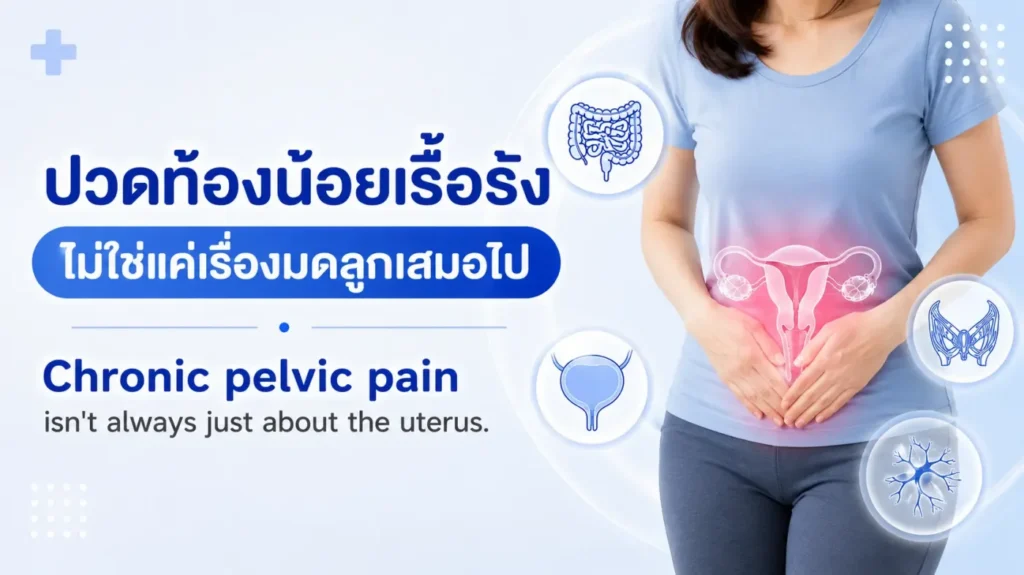
Chronic Lower Abdominal Pain: It’s Not Always About the Uterus
What organs can cause chronic lower abdominal pain in women?
Many women experience occasional lower abdominal pain, such as menstrual cramps, discomfort from bloating, or pain associated with a urinary tract infection. However, if the pain keeps recurring for several months or interferes with work, sleep, sexual activity, or daily life, it should not simply be considered normal.
In medicine, “chronic pelvic pain” generally refers to persistent or recurrent pain in the lower abdomen or pelvic region lasting for several months. American Family Physician 2025 describes chronic pelvic pain in women as pain lasting at least 6 months and reports that it may affect approximately 26% of people with female reproductive organs.
What makes this condition complex is that many organ systems are located close together in the lower abdomen and pelvis. The uterus, ovaries, fallopian tubes, bladder, intestines, muscles, nerves, pelvic bones, hips, and lower spine can all produce pain that may be felt in similar areas. Some people therefore experience lower abdominal pain from gynecological conditions, others from the intestines or bladder, while some may have several overlapping causes.
ACOG notes that chronic pelvic pain cannot always be explained by gynecological disease alone. It may involve the gynecological, urinary, gastrointestinal, and other body systems. Evaluation should therefore extend beyond the uterus and ovaries alone.
Gynecological organs: uterus, ovaries, fallopian tubes, and endometrial tissue
When women experience chronic lower abdominal pain, gynecological conditions are often among the first causes considered. This is reasonable because the uterus, ovaries, and fallopian tubes are located directly within the pelvic region.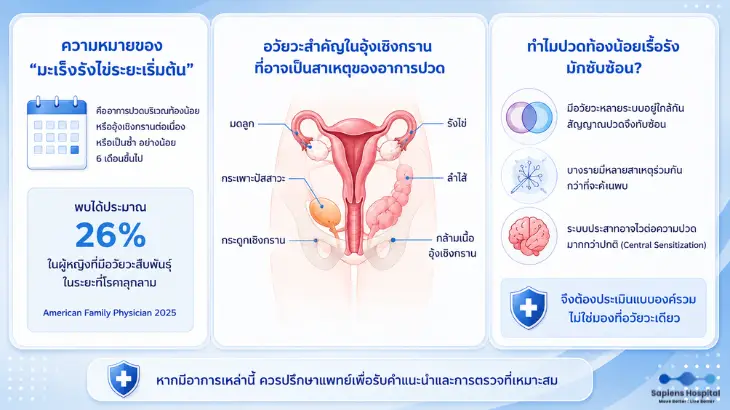
One important group of causes includes endometriosis. This condition occurs when tissue similar to the lining of the uterus is found outside its usual location, such as on the ovaries, peritoneum, intestines, bladder, or behind the uterus. It can contribute to chronic inflammation, adhesions, and different patterns of pain. Some patients experience progressively worsening menstrual pain, chronic pelvic pain, deep pain during sexual intercourse, or pain during bowel movements or urination around the time of menstruation. NICE notes that endometriosis may be associated with pelvic pain, painful periods, pain during intercourse, painful bowel movements or urination, and fertility problems.
Another possible cause is adenomyosis, a condition in which endometrial-type tissue grows into the muscular wall of the uterus. Patients may experience severe menstrual pain, heavy menstrual bleeding, an enlarged uterus, or chronic aching in the lower abdomen. Although it is often identified in people aged 35 years and older, it is not limited to this age group. Ultrasound or, in selected cases, MRI may be used to support evaluation.
Uterine fibroids, or myomas, can also contribute to lower abdominal pain, particularly when they are large, significantly enlarge the uterus, or cause heavy menstrual bleeding that leads to anemia. However, many uterine fibroids cause no symptoms and are discovered incidentally. Finding a fibroid therefore does not necessarily mean that it is the cause of pain. Its location and size, the patient’s symptoms, and examination findings should all be considered together.
The ovaries and fallopian tubes can also be important sources of pain. Certain ovarian cysts, such as endometriomas or “chocolate cysts,” may be associated with severe menstrual pain and chronic pelvic pain. A ruptured ovarian cyst or ovarian torsion more commonly causes acute rather than chronic pain, although people with large or recurrent cysts may experience intermittent pressure or one-sided discomfort.
Pelvic inflammatory disease may cause lower abdominal pain, abnormal vaginal discharge, fever, pain during sexual intercourse, or abnormal bleeding. If not appropriately treated, it may lead to adhesions, chronic pain, or future fertility problems.
Bladder and urinary tract: pain that can closely resemble gynecological pain
The bladder is an organ that may be overlooked in women with chronic lower abdominal pain. Some patients do not have obvious burning during urination but experience pressure or pain above the pubic bone that worsens as the bladder fills and improves somewhat after urination. This pattern may suggest bladder pain syndrome or interstitial cystitis.
Some people experience frequent urination, nighttime urination, or a persistent urge to urinate even though urine testing does not clearly show an infection. These symptoms warrant urinary tract evaluation and should not automatically be attributed to the uterus or ovaries. Recurrent urinary tract infections, ureteric stones, bladder stones, and certain bladder disorders may also cause lower abdominal pain or pain radiating toward the groin. If there is blood in the urine, intermittent cramping pain, pain radiating to the back or groin, or fever, urine testing and further urinary tract evaluation may be appropriate.
Intestines: a common cause that may overlap with pelvic pain
The large intestine lies close to the uterus and ovaries, so intestinal symptoms can sometimes be mistaken for gynecological pain, particularly when lower abdominal pain occurs together with constipation, diarrhea, bloating, or pain related to bowel movements. Irritable bowel syndrome (IBS) is one common possibility. Patients may experience recurrent abdominal pain with diarrhea, constipation, or a feeling of incomplete evacuation. Symptoms may worsen with stress, certain foods, or around the menstrual period.
However, not every intestinal symptom is IBS. If there is weight loss, blood in the stool, black stool, anemia, persistent fever, pain that wakes a person from sleep, or new symptoms developing at an older age, further evaluation may be needed to exclude inflammatory bowel disease, intestinal tumors, diverticulitis, or other conditions.
Intestinal symptoms and endometriosis may also overlap. Some patients with endometriosis experience pain during bowel movements, bloating, or changes in bowel habits, particularly during menstruation. NICE therefore recommends that healthcare professionals consider endometriosis in people with chronic pelvic pain, painful menstruation, or bowel and urinary symptoms that are related to the menstrual cycle.
Pelvic floor muscles, abdominal wall, hips, and spine
A considerable proportion of chronic lower abdominal pain does not originate directly from internal organs. Instead, it may arise from muscles, tendons, joints, or the musculoskeletal structures surrounding the pelvis.
Chronically tense pelvic floor muscles, or pelvic floor myalgia, may cause deep aching pelvic pain, pain during sexual intercourse, pain that worsens with prolonged sitting, or pain radiating to the buttocks, groin, or rectal area. Some patients also experience frequent urination or difficulty with bowel movements because muscles that should normally relax remain persistently tense.
The abdominal wall can also be a source of pain, including abdominal wall pain or myofascial pain. Patients often have a clearly identifiable tender point, with pain worsening when tightening the abdominal muscles, lifting objects, coughing, or moving in certain positions. Without a detailed physical examination, this may be mistaken for pain originating from an internal organ.
The hips, sacroiliac joints, lumbar spine and nerves arising from the lower back may also cause pain that radiates to the lower abdomen, groin, or pelvis, particularly in people who also have back pain or symptoms that worsen with walking, prolonged sitting, or changing position. American Family Physician 2025 emphasizes that chronic pelvic pain management should be multimodal and may include education, self-care, physical therapy, behavioral approaches, medication, and referral to specialists when symptoms do not improve. Surgery should not automatically be considered the first solution for every patient.
Nerves: burning, numbness, radiating pain, or electric-shock-like pain
Nerves in the pelvic and groin regions may also be responsible for pain. Examples include pudendal neuralgia, ilioinguinal neuralgia, iliohypogastric neuralgia, and genitofemoral neuralgia. Symptoms may include burning, shooting, electric-shock-like pain, numbness, or abnormal sensitivity to touch.
Some people experience worse pain after prolonged sitting and improvement when standing or lying down. Others develop pain after a cesarean section, hernia surgery, gynecological surgery, trauma, or pelvic adhesions. Diagnosis usually relies on medical history, pain characteristics and location, neurological examination, and in selected cases, a local anesthetic nerve block may help support the diagnosis.
Pelvic blood vessels: aching pain that may worsen after prolonged standing
Some patients experience a deep aching sensation in the pelvis that becomes worse after prolonged standing or sitting or toward the end of the day and may improve when lying down. This pattern may be associated with pelvic congestion syndrome, in which pelvic veins become dilated or have abnormal blood flow. Because its symptoms may resemble other gynecological disorders, medical assessment and appropriate imaging such as Doppler ultrasound, CT, MRI, or vascular imaging in selected cases may be required.
Pain-processing nervous system and central sensitization
In people who have experienced chronic pain for a long time, the nervous system may become more sensitive to pain, a process known as central sensitization. This means that even after the original trigger has decreased, the nervous system may continue to amplify pain signals or produce pain in response to stimuli that would not normally be painful.
This does not mean that the pain is imaginary. Central sensitization is a neurological mechanism recognized in several chronic pain conditions. Patients may experience pain in several areas, such as pelvic pain, back pain, headaches, muscle pain, together with sleep problems, anxiety, or chronic fatigue.
ACOG notes that many cases of chronic pelvic pain cannot be explained by pathology in a single organ and that treatment may require a comprehensive approach incorporating principles used in the management of other chronic pain conditions.
When should you seek medical attention promptly?
Persistent or life-disrupting chronic lower abdominal pain should already be medically evaluated. However, some symptoms require more urgent attention, including sudden severe lower abdominal pain, severe one-sided pain, dizziness or fainting, high fever, significant nausea or vomiting, a missed period or possible pregnancy accompanied by abdominal pain, heavy abnormal bleeding, foul-smelling vaginal discharge with lower abdominal pain, blood in the stool, unexplained weight loss, or blood in the urine.
For postmenopausal women, vaginal bleeding accompanied by lower abdominal pain should always be medically evaluated because the endometrium, cervix, and other potential causes need systematic assessment.
What will the doctor examine?
Evaluation begins with a medical history that goes beyond simply asking “Where does it hurt?” The doctor may ask how long the pain has been present, whether it is related to menstruation, sexual intercourse, urination, or bowel movements, whether it worsens with standing, sitting, walking, or lifting, and whether there are associated symptoms such as abnormal vaginal discharge, unusual bleeding, fever, weight loss, constipation, diarrhea, or urinary symptoms.
Physical examination may include assessment of the abdomen, back, hips, groin, muscular tender points, and nervous system, as well as a pelvic examination when appropriate. A pelvic examination is not limited to assessing the uterus and ovaries; it may also help evaluate the pelvic floor muscles, areas of tenderness, masses, infection, and abnormalities of the cervix or vagina.
Additional investigations may include a pregnancy test in people of reproductive age, urine tests, blood tests, screening for sexually transmitted infections, ultrasound of the uterus and ovaries, MRI or CT in selected cases, cystoscopy, gastrointestinal endoscopy, or referral to specialists in gastroenterology, urology, rehabilitation medicine, or pain medicine depending on the symptoms.
NICE recommends abdominal and pelvic examination in people with suspected endometriosis to assess for masses, reduced organ mobility, tenderness, or visible lesions. Ultrasound or MRI may be used when indicated, but normal imaging does not necessarily exclude endometriosis.
Treatment depends on the cause and often requires a multidisciplinary approach
If a specific cause is identified, such as endometriosis, adenomyosis, ovarian cysts, pelvic inflammatory disease, recurrent bladder inflammation, IBS, or pelvic floor muscle dysfunction, treatment should be directed toward that condition. However, many patients have more than one contributing factor, such as endometriosis together with pelvic floor dysfunction and IBS, so a single-dimensional treatment approach may not be sufficient.
People whose symptoms are related to menstruation may benefit from NSAIDs or hormonal treatment when clinically appropriate. Suspected endometriosis may be managed with medication, hormonal therapy, or surgery in selected cases. The ESHRE 2022 guideline notes that management of endometriosis-associated pain may include analgesics, hormonal treatment, surgery, and selected non-pharmacological approaches.
People with pelvic floor muscle tension may require specialized physical therapy rather than pain medication alone. Neuropathic pain may require medications used for neuropathic pain, nerve blocks, or assessment by a pain specialist. People with IBS or bladder pain syndrome may require dietary and behavioral modifications together with treatment directed at the affected system.
Importantly, surgery is not the answer for every person with chronic pelvic pain. Surgery performed before the cause has been adequately identified, or before the muscles, nerves, intestines, and bladder have been evaluated, may not improve symptoms as expected. American Family Physician 2025 therefore emphasizes multimodal treatment and ongoing follow-up rather than relying on a single treatment approach.
How to care for yourself when you have chronic lower abdominal pain
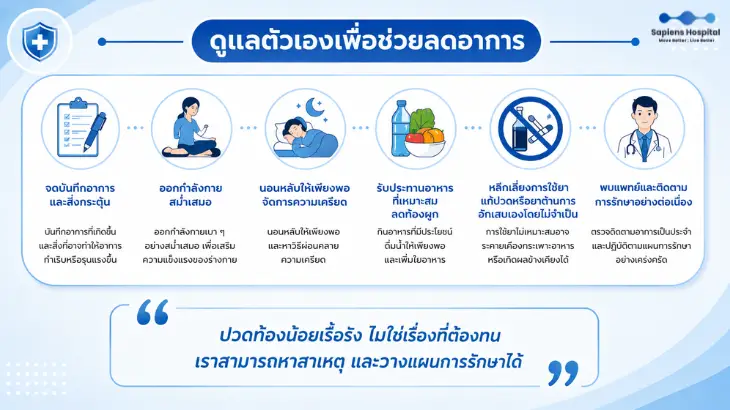
Start by keeping a detailed record of your symptoms: when during the menstrual cycle the pain occurs, how many days it lasts, its severity, and whether it is associated with bowel movements, urination, food, prolonged sitting, walking, or sexual intercourse. Recording these details can help the doctor distinguish possible causes more effectively than simply saying, “I’ve had lower abdominal pain for a long time.”
Avoid repeatedly using strong painkillers or antibiotics without knowing the cause. If constipation is present, pay attention to hydration, dietary fiber, and regular bowel habits. If prolonged sitting worsens the pain, posture should be considered and assessment of the pelvic floor or hip muscles may be appropriate. If pain is related to menstruation or sexual intercourse, consultation with a gynecologist may be appropriate to evaluate for endometriosis and other pelvic conditions.
Most importantly, chronic pain should not simply be dismissed as “overthinking” or “not being able to tolerate pain.” Persistent pain is a symptom that warrants appropriate evaluation and should be taken seriously.
Frequently Asked Questions
- Is chronic lower abdominal pain in women always caused by the uterus?
No. Although the uterus and ovaries are common potential sources, chronic lower abdominal pain may also originate from the bladder, intestines, pelvic floor muscles, nerves, hips, spine, or several overlapping causes. - I have lower abdominal pain before my period every month. What should be considered?
It may be primary menstrual pain, but if the pain progressively worsens, begins several days before menstruation, continues after the period ends, occurs during sexual intercourse, or is associated with painful bowel movements or urination during menstruation, evaluation for endometriosis or adenomyosis may be appropriate. - If my ultrasound is normal, does that mean there is no disease?
Not necessarily. Ultrasound is useful for evaluating the uterus, ovaries, cysts, and certain masses, but some conditions, including certain forms of endometriosis, pelvic floor muscle dysfunction, neuropathic pain, or bladder pain syndrome, may not be visible on a routine ultrasound. - What can cause lower abdominal pain with frequent urination?
It may be related to the bladder, such as recurrent cystitis or bladder pain syndrome, or to a pelvic mass pressing on the bladder. Urine testing and further evaluation of associated symptoms may be appropriate. - If lower abdominal pain occurs with constipation or diarrhea, should I see a gynecologist or a gastroenterologist?
You may start with a general physician or gynecologist. If bowel symptoms are prominent, such as blood in the stool, unexplained weight loss, anemia, or a significant change in bowel habits, evaluation by a gastroenterologist may also be needed. - Can chronic lower abdominal pain be treated?
Many patients can experience substantial improvement when the cause is correctly identified and treatment addresses several contributing factors. Some people, however, have chronic pain conditions that require ongoing management. The goals are to identify contributing causes, reduce pain, restore sleep, work and daily function, and avoid unnecessary treatment.
Chronic lower abdominal pain in women is complex and may arise from several organs and systems, not only the uterus or ovaries. Possible causes include endometriosis, adenomyosis, uterine fibroids, ovarian cysts, pelvic inflammatory disease, bladder conditions, intestinal disorders, pelvic floor muscles, nerves, hips, or the spine.
A thorough evaluation involves taking a detailed history, performing a comprehensive physical examination, and selecting additional investigations according to the individual symptoms rather than focusing on a single organ. When the underlying cause or pain mechanism is better understood, treatment can be more appropriately targeted and may reduce recurrent unexplained pain.
If lower abdominal pain repeatedly occurs for several months, interferes with daily life, occurs during sexual intercourse, is related to menstruation, is accompanied by urinary or bowel changes, or occurs with abnormal bleeding, medical evaluation is recommended.
For information and appointments
Sapiens Hospital | Move Better : Live Better
Tel. 02-111-3703
Academic References
American College of Obstetricians and Gynecologists. Chronic Pelvic Pain. ACOG Practice Bulletin No. 218. Obstetrics & Gynecology. 2020.
Meisenheimer ES, Carnevale AM. Chronic Pelvic Pain in Women: Evaluation and Treatment. American Family Physician. 2025;111(3):218-229.
National Institute for Health and Care Excellence. Endometriosis: diagnosis and management.
NICE Guideline NG73, amended 2024. European Society of Human Reproduction and Embryology. ESHRE Guideline: Endometriosis.
2022.