
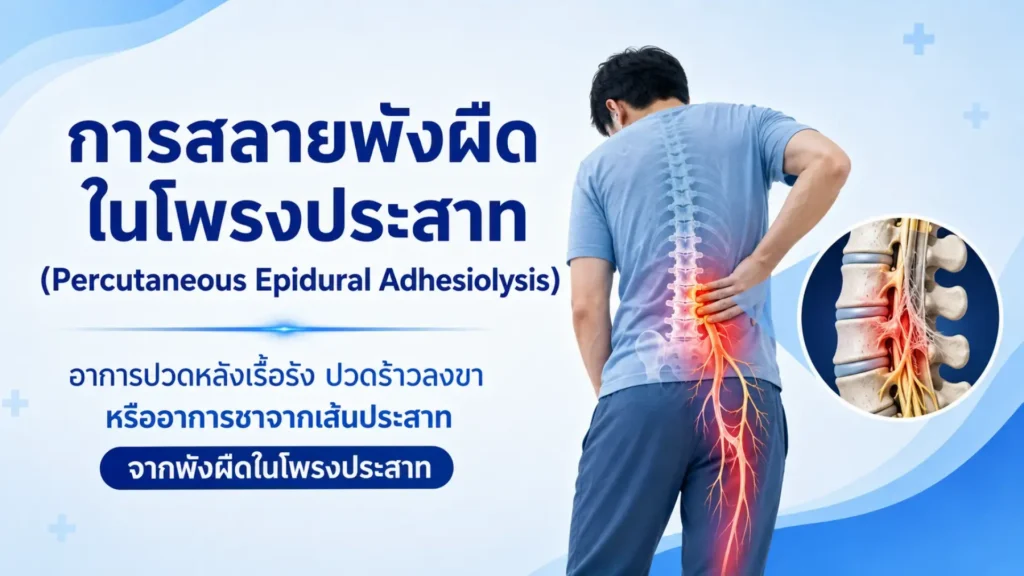
Percutaneous Epidural Adhesiolysis
Minimally Invasive Lysis of Epidural Adhesions
Chronic low back pain, radiating leg pain, or numbness related to nerve irritation are common problems, particularly in patients who have previously undergone spinal surgery or have had prolonged nerve root compression associated with a herniated disc. Some patients may continue to experience persistent or recurrent pain despite treatment with medication, physical therapy, epidural steroid injection (ESI), or even surgery.
One factor that may contribute to persistent symptoms in selected patients is “epidural fibrosis” or “epidural adhesions”. Scar tissue around the epidural space may restrict normal movement of the nerve root and may be associated with ongoing irritation or inflammation. In some patients, symptoms may persist even when MRI does not demonstrate severe structural compression. However, epidural fibrosis seen on imaging does not necessarily cause symptoms in every patient, so clinical assessment is essential.
Q&A: How Do Adhesions Develop Around the Nerves?
Following surgery, chronic inflammation, or prolonged nerve root irritation, the body’s natural healing process can result in scar tissue forming around structures in the epidural space. In selected patients, these adhesions may be associated with:
- Restriction or tethering of nerve root movement
- Changes in local blood flow around the nerve
- Persistent nerve root irritation or inflammation
- Irritation of the sensory dorsal root ganglion (DRG)
- Reduced distribution of medication within the epidural space, making it more difficult for medication to reach the targeted area
Patients may experience chronic back pain, radiating leg pain, numbness or burning sensations, reduced walking tolerance, or increased discomfort after prolonged sitting or standing. These symptoms can have several causes, and inflammation, adhesions, nerve compression, and other structural abnormalities should be evaluated together.
Percutaneous Epidural Adhesiolysis Technique
Percutaneous Epidural Adhesiolysis is a minimally invasive procedure in which a specialized small catheter is introduced into the epidural space under real-time X-ray guidance (fluoroscopy). The catheter is directed toward the suspected area of adhesion or narrowing to facilitate mechanical adhesiolysis and improve delivery of medication to the targeted area. Techniques that may be used include:
- Racz Catheter: A specialized flexible catheter traditionally used for percutaneous epidural adhesiolysis
- Steerable Catheter: A catheter whose tip can be directed by the physician toward a selected target area
- Balloon Epidural Adhesiolysis: A technique using a catheter with a small inflatable balloon. Once positioned at a selected area of adhesion or narrowing, the balloon may be carefully inflated for short periods to create additional space around the nerve and mechanically mobilize adhesions. This technique may be considered in selected patients with spinal stenosis or foraminal stenosis, depending on clinical findings and the physician’s assessment.
Indications and Procedure
Patients Who May Be Considered for This Treatment (Indications)
- Persistent Spinal Pain Syndrome after Surgery (formerly Failed Back Surgery Syndrome; FBSS): Persistent back or radiating leg pain following spinal surgery
- Epidural Fibrosis: Clinically relevant epidural scar tissue or adhesions suspected to contribute to persistent symptoms
- Disc Herniation with Radicular Pain: Persistent symptoms despite appropriate conservative treatment such as medication and physical therapy
- Spinal Stenosis / Foraminal Stenosis: Narrowing of the spinal canal or neural foramen in appropriately selected patients
- Chronic Radicular Pain: Persistent pain radiating along a nerve root distribution
- Selected Patients Who May Not Be Suitable for Major Surgery: Treatment may be considered after assessment of overall health, imaging findings, symptoms, and alternative treatment options
Procedure
- Preparation and Pain Control: The physician reviews MRI/CT and the patient’s medical history to plan the procedure. Local anesthesia is commonly used, with sedation when appropriate. The level of sedation is individualized according to the patient’s condition and procedural requirements.
- Accessing the Epidural Space: A small needle and catheter are introduced into the epidural space, commonly through the sacral hiatus (caudal approach) or another appropriate approach selected by the physician, under real-time fluoroscopic guidance.
- Epidurography: Contrast material is injected under fluoroscopy to evaluate catheter position and the pattern of epidural spread and to identify areas where distribution may be restricted.
- Adhesiolysis and Targeted Medication: The physician carefully manipulates the catheter and, when indicated, may use a balloon technique to mechanically mobilize adhesions. Medications may then be administered according to the patient’s condition and the selected procedural protocol, which can include:
- Local Anesthetic: Used for analgesia during and after the procedure
- Steroid: May be used to reduce inflammation around an irritated nerve root when clinically appropriate
- Hyaluronidase: An enzyme that may be used in some protocols to facilitate the spread of injected medication through tissue planes
- Hypertonic Saline: Used in some adhesiolysis protocols. Its use, concentration, volume, and administration technique must be carefully selected because inadvertent intrathecal administration can cause serious complications.
Treatment Outcomes, Benefits, and Clinical Limitations
Recovery and Expected Outcomes
After the procedure, patients are monitored until they meet appropriate discharge criteria. Depending on the procedure and the patient’s condition, some may be able to return home on the same day. Temporary soreness, heaviness, numbness, or increased radiating discomfort can occur after the procedure and should be monitored. Some appropriately selected patients experience improvement in pain and function following percutaneous adhesiolysis; however, the degree and duration of benefit vary considerably between individuals. Outcomes depend on the underlying condition, severity of disease, previous surgery, rehabilitation, and other patient-specific factors. If symptoms recur, the need for another procedure should be reassessed individually rather than performed according to a fixed schedule.
Comparison of Benefits and Limitations
| Potential Benefits of the Procedure | Limitations and Possible Complications |
| Minimally invasive and does not require open surgery. Recovery is generally shorter than after major spinal surgery. It may improve pain and function in appropriately selected patients with chronic refractory radicular pain and may help some patients avoid or postpone additional surgery. | It cannot correct all structural spinal abnormalities, and not every patient will benefit. Outcomes depend on appropriate patient selection and procedural technique. Potential complications include temporary increased pain, dural puncture and cerebrospinal fluid leak with headache, bleeding, infection, allergic or contrast-related reactions, catheter-related complications, nerve irritation or injury, and temporary numbness or weakness. Serious neurological complications are uncommon but possible. |
Options If Symptoms Do Not Improve: If symptoms persist, the physician will reassess the source of pain and consider other appropriate treatment options. Depending on the diagnosis, these may include other interventional pain procedures, spinal cord stimulation for selected chronic neuropathic pain conditions, or referral to a spine surgeon when surgically correctable structural pathology is present. Other potential pain generators, such as facet joints, sacroiliac joints, hip pathology, or muscular and myofascial conditions, may also need to be evaluated.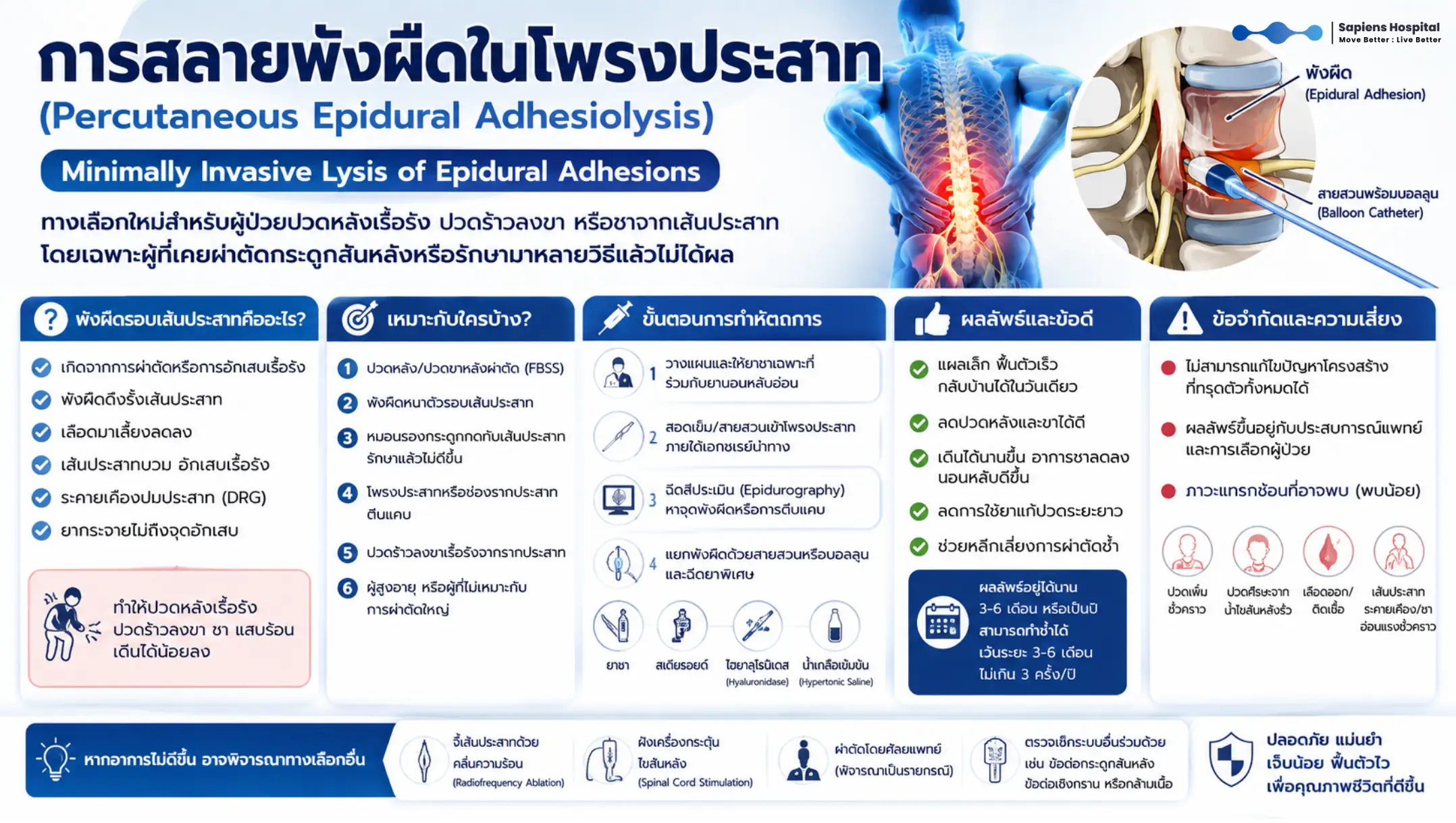
References
Helm S 2nd, Benyamin RM, Chopra P, Deer TR, Justiz R. Percutaneous adhesiolysis in the management of chronic low back pain in post lumbar surgery syndrome and spinal stenosis: a systematic review. Pain Physician. 2012;15:E435-E462.
Helm S 2nd, Noe C, Racz GB. Epidural Lysis of Adhesions: What Every Interventional Pain Physician Needs to Know. Pain Physician. 2025;28:249-257.
Kim DH, Shin JW, Choi SS. Percutaneous epidural balloon neuroplasty: a narrative review of current evidence. Anesth Pain Med. 2022;17:361-370.
Cho PG, Ji GY, Yoon YS, Shin DA. Clinical Effectiveness of Percutaneous Epidural Neuroplasty According to the Type of Single-Level Lumbar Disc Herniation: A 12-Month Follow-Up Study. J Korean Neurosurg Soc. 2019;62(6):681-690.
Gerdesmeyer L, Wagenpfeil S, Birkenmaier C, et al. Percutaneous epidural lysis of adhesions in chronic lumbar radicular pain: a randomized, double-blind, placebo-controlled trial. Pain Physician. 2013;16:185-196.
Lee F, Jamison DE, Hurley RW, Cohen SP. Epidural lysis of adhesions. Korean J Pain. 2014;27(1): 3-15.
Manchikanti L, Singh V, Cash KA, Pampati V, Datta S. Assessment of effectiveness of percutaneous adhesiolysis and caudal epidural injections in managing post lumbar surgery syndrome. Pain Physician. 2009;12:361-378.
Oh WS, Hong KH, Lee SC. Comparative Study for Analgesic and Adverse Effects of 8% and 10% Hypertonic Saline in Epidural Adhesiolysis. J Korean Pain Soc. 2000;13(1):74-78.