
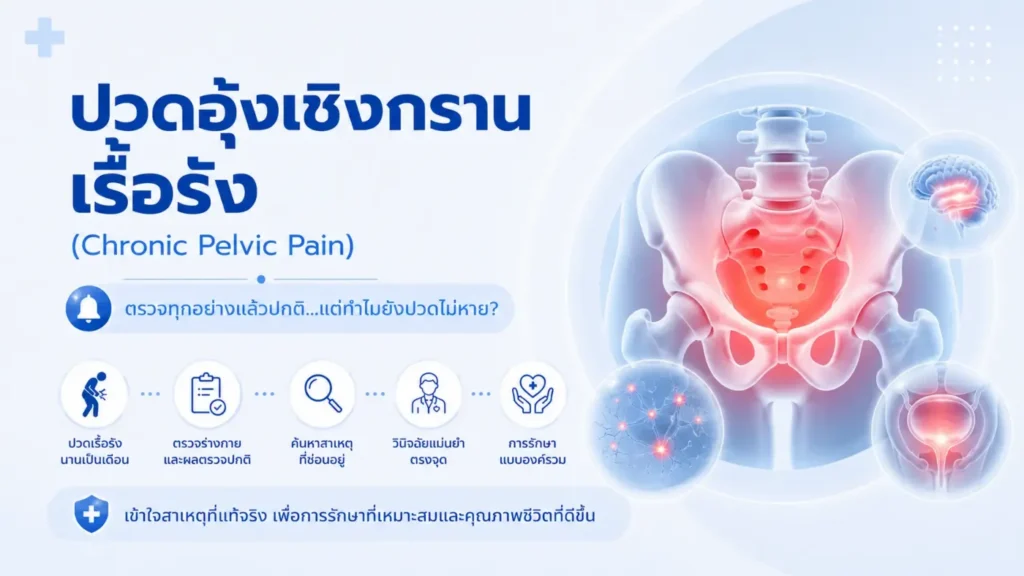
Chronic Pelvic Pain: When Every Test Is Normal… Why Does the Pain Still Persist?
“When Test Results Are Normal, but the Pain Persists”
This is a common experience among patients with Chronic Pelvic Pain (CPP). Laboratory tests or imaging may appear normal, yet patients may continue to experience significant pain for months or years. Examples include:
- A woman in her 40s: She has experienced chronic pelvic pain for more than 10 years, including burning vaginal pain, pain during urination, pain with bowel movements, and worsening pain when standing or walking for prolonged periods. She has undergone pelvic examinations, ultrasound, and MRI, but no clear cause has been identified.
- A middle-aged man: He experiences pelvic pain and frequent urination and has been treated for years for presumed chronic prostatitis, despite repeated investigations showing no evidence of infection or another clear cause.
A Condition More Common Than Many People Realize
Chronic pelvic pain is an important health problem that can be under-recognized and may substantially affect physical, psychological, sexual, and social well-being.
- In women: Chronic pelvic pain is relatively common, although reported prevalence varies considerably depending on the population studied and how chronic pelvic pain is defined.
- In men: Although discussed less frequently, chronic pelvic pain can also occur in men. Symptoms may include perineal pain, testicular or genital pain, pain during or after ejaculation, urinary symptoms, or symptoms resembling chronic prostatitis.
These symptoms can significantly affect work, sleep, exercise, relationships, sexual health, emotional well-being, and overall quality of life.
Q&A: Why Do I Still Have Pain When All My Tests Are Normal?
Many people assume that a normal MRI or other normal investigations mean there cannot be an important cause of pain. In reality, chronic pelvic pain does not arise solely from abnormalities in one organ. Pain may involve several systems simultaneously:
- Pelvic organs
- Pelvic floor muscles
- Peripheral nerves and nerve roots
- Autonomic nervous system
- Pain-processing pathways in the brain and spinal cord
Therefore, normal test results do not mean that a patient’s pain is not real. Important clues may be found in the pattern of symptoms, a detailed physical examination, and assessment of the nervous and musculoskeletal systems that routine imaging may not fully evaluate.
When Pelvic Organs and Systems Begin to Influence One Another
Pelvic organs and structures—including the bladder, bowel, uterus, vagina, prostate, muscles, and nervous system— are interconnected through complex neural pathways. When one area produces persistent pain signals, changes in pain processing may occur and symptoms can sometimes be experienced in neighboring pelvic structures.
This helps explain why some patients experience several symptoms at the same time, such as lower abdominal pain, pain during urination, pain with bowel movements, pain during sexual activity, or perineal pain, even when examination of each individual organ does not reveal a severe abnormality.
When pain persists for a long time, changes in the nervous system may contribute to Central Sensitization, in which pain-processing pathways in the brain and spinal cord become more responsive to sensory input. As a result, pain may persist even after the original disease or tissue abnormality has improved or been treated.
Pelvic Floor Dysfunction
The pelvic floor muscles are another potential source or contributor to pelvic pain that can sometimes be overlooked. Patients may experience lower abdominal pain, perineal pain, pain during urination or bowel movements, or pain during sexual activity.
However, Pelvic Floor Dysfunction is not necessarily the primary cause in every patient. It may develop secondary to persistent guarding or muscle tension associated with pain from other conditions such as Endometriosis, Bladder Pain Syndrome, Pudendal Neuralgia, or Chronic Pelvic Pain Syndrome in men. Specialized pelvic floor physical therapy, including Pelvic Floor Relaxation Therapy, may therefore be helpful in appropriately selected patients, while other contributing causes should also be assessed and treated.
Similar Symptoms Can Have Different Causes
Chronic pelvic pain is not a single disease. It is a complex clinical condition or syndrome that may arise from many different causes:
- Endometriosis: An important cause of pelvic pain in women. Symptoms may include severe menstrual pain, chronic lower abdominal or pelvic pain, and pain during sexual intercourse. The severity of pain does not necessarily correspond to the extent of endometriosis lesions.
- Pelvic Venous Disorder / Pelvic Congestion Syndrome: Dilated or refluxing pelvic veins may contribute to chronic pelvic pain in selected patients. Symptoms can include a dull or aching pelvic pain that may worsen after prolonged standing or later in the day and may occur after sexual intercourse. Diagnosis requires appropriate clinical and imaging assessment. Pelvic vein embolization may be considered in appropriately selected patients with confirmed symptomatic pelvic venous disease.
- Bladder Pain Syndrome / Interstitial Cystitis: Patients may experience pelvic or bladder-associated pain, urinary frequency, urgency, or discomfort related to urination, often without evidence of a conventional urinary tract infection.
- Chronic Prostatitis/Chronic Pelvic Pain Syndrome (CP/CPPS): In many men, symptoms occur without evidence of bacterial infection. The condition may involve interactions among the pelvic floor muscles, peripheral nerves, urinary system, autonomic nervous system, and pain-processing pathways rather than infection alone.
- Pudendal Neuralgia: Pain involving the pudendal nerve may be associated with irritation or entrapment along its course, including around Alcock’s Canal. The pudendal nerve supplies sensation to areas of the perineum, genital region, and around the anus. Typical symptoms may include burning or neuropathic pain in these areas that is often aggravated by sitting.
Peripheral Nerves: Another Potentially Overlooked Source of Pain
In addition to the Pudendal Nerve, several other peripheral nerves provide sensation to the pelvis, groin, and genital region, including:
- Ilioinguinal Nerve
- Iliohypogastric Nerve
- Genitofemoral Nerve
When these nerves become irritated, compressed, or injured—sometimes following procedures such as hernia repair, cesarean section, hysterectomy, or other pelvic surgery—patients may experience groin pain, suprapubic pain, genital pain, inner-thigh pain, burning sensations, or electric-shock-like pain. Routine blood tests, ultrasound, or MRI may not always demonstrate peripheral nerve-related pain, which is why careful clinical assessment remains important.
Treatment Options When Symptoms Do Not Improve
When medication, rehabilitation, pelvic floor therapy, and treatment of the underlying condition are insufficient, selected interventional pain procedures may be considered. Some nerve blocks can have both diagnostic and therapeutic roles:
| Suspected Pain Source / Nerve | Potential Targeted Procedure |
| Pudendal Nerve | Image-guided Pudendal Nerve Block may be considered in selected patients when pudendal neuralgia is suspected. |
| Nerves of the Groin / Genital Region | Ilioinguinal, Iliohypogastric, or Genitofemoral Nerve Block may be considered when the clinical pain distribution suggests involvement of these nerves. |
| Visceral / Sympathetically Mediated Pelvic Pain (selected patients with complex pelvic pain patterns) | Procedures such as Superior Hypogastric Plexus Block or Ganglion Impar Block may be considered in carefully selected patients according to the suspected pain mechanism and clinical indication. Response varies between individuals and these procedures are not appropriate for every type of chronic pelvic pain. |
Neuromodulation Technology
For carefully selected patients with severe, persistent symptoms that have not responded adequately to more conservative treatment, neuromodulation may be considered. These approaches use electrical stimulation to modify neural activity rather than intentionally destroying the nerve:
- Sacral Neuromodulation
- Dorsal Root Ganglion Stimulation (DRG Stimulation)
The role and evidence for each neuromodulation technique differ according to the underlying condition. Careful diagnosis, patient selection, specialist assessment, and discussion of potential benefits, limitations, and risks are essential before treatment.
Summary and Practical Q&A
- Can chronic pelvic pain be cured? The outcome depends on the underlying cause, duration of symptoms, and contributing pain mechanisms. Treatment goals may include reducing pain, improving function and quality of life, addressing treatable causes, and helping patients return to meaningful daily activities.
- Should I stop exercising? Complete avoidance of physical activity is generally not recommended unless medically necessary. Activities may need to be modified according to symptoms. For example, prolonged sitting or cycling may aggravate symptoms in some patients with pudendal or perineal pain. An individualized rehabilitation plan may be helpful.
- Can chronic pelvic pain be prevented? Not all causes are preventable. Early assessment of persistent or recurrent pelvic pain may help identify treatable conditions and reduce unnecessary delays in appropriate care. The key is to determine which structures and pain mechanisms are contributing to the symptoms and develop an individualized treatment plan.
Selected References
European Association of Urology (EAU). EAU Guidelines on Chronic Pelvic Pain. Arnhem, The Netherlands: European Association of Urology; 2025.
Engeler DS, Baranowski AP, Borovicka J, et al. EAU Guidelines on Chronic Pelvic Pain: Management of Chronic Primary Pelvic Pain Syndromes. Eur Urol Focus. 2025.
American College of Obstetricians and Gynecologists (ACOG). Chronic Pelvic Pain. ACOG Practice Bulletin. Obstet Gynecol. 2020;135:e98-e109.
Clemens JQ, Erickson DR, Varela NP, et al. Diagnosis and Treatment of Interstitial Cystitis/Bladder Pain Syndrome. American Urological Association (AUA) Guideline. Updated 2022.
McReynolds D, Shiraz R, Tangey MA, Egerton T, Frawley H. Effectiveness of multidisciplinary treatment compared with single-discipline treatment of female chronic pelvic pain: a systematic review and meta-analysis. BJOG. 2025.
Grundy L, Caldwell A, Brierley SM. Mechanisms underlying pelvic pain and cross-organ sensitisation. Nat Rev Gastroenterol Hepatol. 2019;16(10):593-608.
FitzGerald MP, Anderson RU, Potts J, et al. Randomized multicenter clinical trial of myofascial physical therapy in women with interstitial cystitis/painful bladder syndrome and pelvic floor tenderness. J Urol. 2012;187(6):2113-2118.
Shoskes DA, Nickel JC, Dolinga R, Prots D. Clinical phenotyping of patients with chronic prostatitis/chronic pelvic pain syndrome and correlation with symptom severity. World J Urol. 2009;27(2):283-288.
Labat JJ, Riant T, Robert R, Amarenco G, Lefaucheur JP, Rigaud J. Diagnostic criteria for pudendal neuralgia by pudendal nerve entrapment (Nantes Criteria). Neurourol Urodyn. 2008;27(4):306-310.
Deer TR, Pope JE, Lamer TJ, et al. The Neuromodulation Appropriateness Consensus Committee (NACC): Recommendations for Neuromodulation in Chronic Pain. Neuromodulation. 2022.