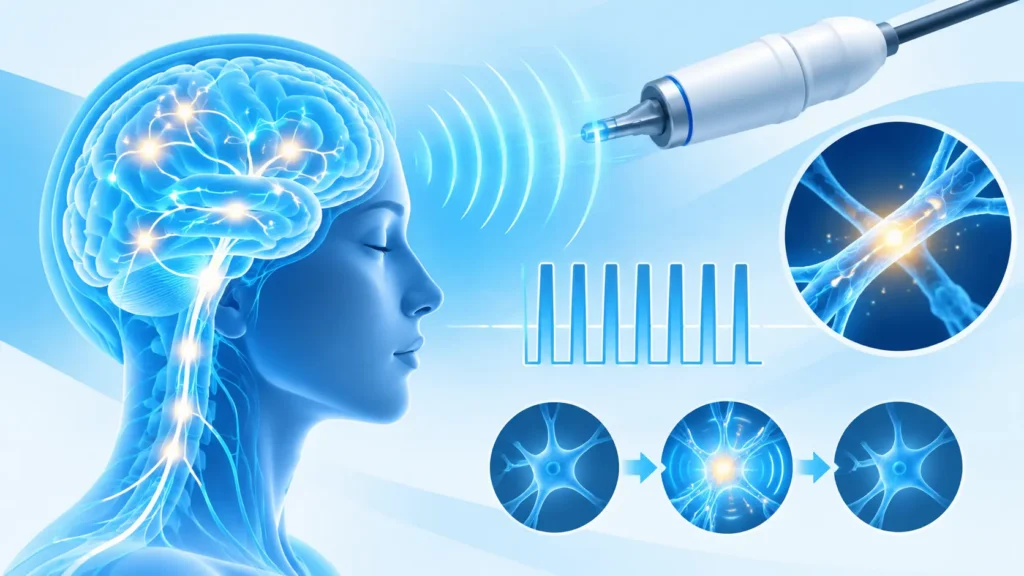
Neuromodulation using High-Voltage Long-Duration Pulsed Radiofrequency
High-Voltage Long-Duration Pulsed Radiofrequency (PRF) for Chronic Neuropathic Pain
Chronic Neuropathic Pain is a common condition that severely affects the patient’s quality of life, often manifesting as burning, shooting, electric shock-like sensations, or pain even with light touch. In the early stages, the pain is usually caused by nerve inflammation, which responds well to medication, physical therapy, or anti-inflammatory injections. However, when the pain is prolonged, the nervous system begins to alter until a state of “abnormal hypersensitivity to pain” occurs. This means that even after the inflammation subsides, the patient continues to suffer from pain.
For this reason, the current concept in pain medicine has transitioned from “nerve destruction” to “Neuromodulation” to reduce abnormal pain signaling while preserving the original structure and function of the nerve as much as possible.
Q&A: Differences from Conventional RFA and In-depth Mechanisms
How does Pulsed Radiofrequency (PRF) differ from thermal ablation?
- Conventional RF Ablation (traditional technique): Uses high-temperature thermal energy to directly ablate the target nerve and tissue structures to disrupt the pain signaling circuit.
- Pulsed Radiofrequency (PRF): Delivers radiofrequency energy in short bursts (Pulses) combined with temperature control at the needle tip not exceeding 42 degrees Celsius. Therefore, there is no severe destruction of nerve tissues as seen in thermal ablation.
Why is Neuromodulation currently preferred over nerve destruction?
Because most nerves do not function solely to transmit pain signals but also control sensation, muscle motor commands, and limb movements. If large nerves or peripheral nerve roots are excessively destroyed, it may induce severe complications such as muscle weakness, profound numbness, muscle atrophy, or the development of a new type of nerve pain (Deafferentation pain) that is more difficult to treat.
What was High-Voltage Long-Duration developed to resolve?
Traditional PRF techniques typically use a voltage of around 45 volts for 2–5 minutes. In patients with long-standing chronic neuropathic pain, the analgesic effect often does not last long. Consequently, High-Voltage Long-Duration PRF technology was developed by adjusting the parameters to an increased voltage of 85–90 volts and extending the duration to 900 seconds (approximately 15 minutes) to create a broader and more powerful electrical field to balance the nervous system.
Clinical Precaution: Continuously increasing the voltage does not always translate to better results. In patients with severely hypersensitive nervous systems, applying excessively high voltage may trigger temporary pain exacerbation or a pain flare-up. Pain specialists must, therefore, tailor the parameters specifically according to the characteristics and sensitivity of the nerve in each individual patient.
Mechanisms of Action
Although still under further study, current empirical evidence indicates that this technique has positive effects across multiple dimensions, as follows:
- Reduces abnormal pain signaling: Inhibits and desensitizes nerves that excessively transmit pain impulses.
- Reduces hypersensitivity of the Dorsal Root Ganglion (DRG): Which serves as a major connection station and amplifier for pain signals before they enter the spinal cord.
- Reduces Neuroinflammation: Inhibits the secretion of certain inflammatory mediators associated with the chronic pain cycle.
- Reduces Central Sensitization: Helps balance and reduce the exaggerated amplification of pain signals in certain parts of the brain and spinal cord.
Clinical Indications: Who is suitable for this treatment?
This procedure is highly suitable for patients suffering from pain due to chronic nerve lesions or injuries that are refractory to medication, only experience short-term relief from steroid injections, do not wish to undergo surgery, or have anatomical structures unsuitable for permanent ablation. The main disease groups include:
1. Postherpetic Neuralgia (PHN): Chronic nerve pain following shingles.
2. Trigeminal Neuralgia: Pain of the 5th cranial nerve.
3. Occipital Neuralgia: Pain of the occipital nerve.
4. Cervical / Lumbar Radicular Pain: Cervical nerve root pain radiating down the arm, or lumbar nerve root pain radiating down the leg.
5. Persistent Spinal Pain Syndrome (PSPS/FBSS): Chronic pain after spinal surgery.
6. Complex Regional Pain Syndrome (CRPS): A complex regional pain syndrome involving autonomic nervous system dysfunction.
7. Peripheral Neuropathy: Peripheral nerve degeneration or nerve pain following various structural surgeries.
Q&A: Superior advantages over repeated steroid injections
How does this procedure differ from steroid injections?
Injecting steroids around the nerve or into the epidural space (ESI) primarily aims to “reduce the inflammatory process,” whereas Pulsed Radiofrequency focuses directly on “modulating nerve impulse transmission.”
Safety Advantages (Cumulative Steroid Exposure)
A critical limitation of steroid injections is the cumulative amount of steroids over the long term. In chronic pain patients who often experience relapses and require multiple injections per year, a high cumulative dose exacerbates the risk of severe side effects such as critically high blood sugar levels, severe osteoporosis, reduced immunity, Adrenal insufficiency, and overall hormonal system fluctuations.
Key Role: Performing Pulsed Radiofrequency thus emerges as a highly effective pain management alternative, utilizing only an electrical field and low temperatures to modulate nerve impulses. This significantly enables physicians to reduce the frequency and the necessity of repeated steroid use in long-term patients.
Clinical Outcomes & Safety
Expected Outcomes: Research indicates that many patients experience a significant reduction in pain levels. In patients who respond well, the pain can:
- Decrease by more than 50% and last for several months, resulting in improved sleep quality, reduced reliance on pain medication, and high patient satisfaction with the treatment outcome.
- Common Complications (mild): There may be localized soreness or tightness at the needle insertion site, temporary burning pain, or a pain flare-up during the first 1–2 weeks, along with slight tingling or numbness, which will gradually resolve on their own.
- Very Rare Complications: Bleeding, infection, or nerve irritation leading to temporary weakness. However, the risk of causing permanent nerve damage or destruction is substantially lower than that of general thermal ablation techniques and is highly safe when performed by a pain specialist under fluoroscopic guidance.
References
Cai S, et al. Comparing the efficacy and safety of high-voltage and standard-voltage pulsed radiofrequency for postherpetic neuralgia: a systematic review and meta-analysis. Front Neurol. 2024.
Sun CL, et al. High-voltage, long-duration pulsed radiofrequency to the dorsal root ganglion provides improved pain relief for herpes zoster neuralgia in the subacute stage. Pain Physician. 2023.
Wen H, et al. Outcomes of twice repeated high-voltage long-duration pulsed radiofrequency therapy in subacute postherpetic neuralgia. J Pain Res. 2024.
Chua NHL, et al. Pulsed radiofrequency treatment in interventional pain management: mechanisms and potential indications. Pain Pract. 2011.
Van Boxem K, et al. Pulsed radiofrequency: a review of mechanisms and clinical applications. Anesth Pain Med. 2014.
Cosman ER Jr, et al. Factors that affect radiofrequency lesion size and tissue effects. Pain Med. 2014.
Lee MS, et al. Safety of epidural steroids: a review. Anesth Pain Med. 2021.
CMS Local Coverage Determination: Epidural Steroid Injections for Pain Management.
Endocrine Society Clinical Practice Guideline: Glucocorticoid-Induced Adrenal Insufficiency. 2024.