

Day Surgery: What Is It, and Can You Go Home the Same Day? | Sapiens Hospital
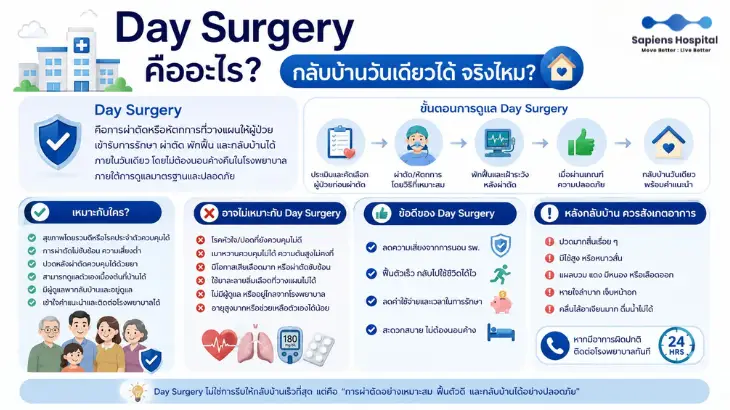
Day Surgery, or same-day surgery, is a planned surgical approach in which patients undergo surgery and are discharged home on the same day. Patients must undergo appropriate preoperative assessment, pain and nausea management, and safe postoperative monitoring before discharge.
When people hear the word “surgery”, many imagine staying in the hospital for several days, prolonged fasting, a large surgical wound, a long recovery period, and extensive preparation.
Today, however, many surgical procedures have changed significantly. Surgical techniques have become less invasive, anesthetic medications are shorter-acting and safer, pain management has improved, and preoperative and postoperative care has become more standardized. These developments have led to an approach known as “Day Surgery” or “same-day surgery.”
Many people are interested in this option but still have questions such as:
- Is it really safe to go home on the same day after surgery?
- Who is suitable for Day Surgery?
- Is Day Surgery the same as minor surgery?
- Do I need someone to take me home?
- What should I do if I experience pain or another problem after returning home?
This article explains what Day Surgery is, its benefits, who may be suitable, how to prepare, and when a doctor may recommend an overnight hospital stay instead.
What Is Day Surgery?
“Day Surgery”, also known as “same-day surgery” or “ambulatory surgery”, refers to a planned surgical procedure or intervention in which the patient is admitted, undergoes the procedure, recovers after surgery, and is discharged home on the same day without an overnight hospital stay.
The key concept is that it is “planned from the beginning.” Day Surgery does not mean rushing a patient home without proper assessment. It is a structured care pathway beginning before surgery, including patient selection, evaluation of underlying medical conditions, selection of anesthesia, pain-management planning, prevention of nausea and vomiting, and clearly defined discharge criteria. Therefore, good Day Surgery is not about “performing surgery as quickly as possible”, but about “appropriate surgery, good recovery, and safe discharge home.”
How Is Day Surgery Different from Minor Surgery?
Day Surgery is often mistaken for minor surgery, but they are not the same. “Minor surgery” generally refers to smaller procedures such as removing a cyst or subcutaneous lump, suturing a wound, or draining an abscess. These procedures may be performed under local anesthesia and usually take a short time. “Day Surgery” is a broader concept and may include procedures requiring regional anesthesia or general anesthesia when the procedure and patient are appropriate and a safe postoperative care system is available.
Examples of procedures that may be performed as Day Surgery in appropriately selected patients include:
- Removal of subcutaneous lumps, cysts, or lipomas
- Drainage of certain abscesses or collections of pus
- Certain hernia operations
- Certain hemorrhoid procedures
- Certain laparoscopic procedures in appropriately selected patients
- Certain endoscopic or diagnostic procedures
- Certain orthopedic or sports medicine procedures
- Certain pain interventions or procedures that do not require an overnight hospital stay
However, not every procedure is suitable for Day Surgery, and not every patient should go home on the same day. The decision depends on both the type of surgery and the patient’s overall health.
Can You Really Go Home on the Same Day?
The answer is “yes, for appropriately selected patients who meet postoperative safety criteria.” After surgery, patients are monitored in the recovery area to assess whether they:
- Are fully awake and alert
- Are breathing well
- Have stable blood pressure, pulse, and oxygen levels
- Have pain that can be adequately controlled
- Do not have significant nausea or vomiting
- Have no abnormal bleeding
- Can drink fluids or eat light food when appropriate
- Can walk or move according to the requirements of the procedure
- Have a responsible adult to take them home
Patients should also understand their postoperative instructions and warning signs. If a patient continues to have severe pain, significant nausea or vomiting, bleeding, unstable blood pressure, excessive drowsiness, or if the doctor determines that discharge is not yet safe, the patient may need further observation or an overnight stay. The goal of Day Surgery is not to “send everyone home on the same day”, but to “discharge patients when it is safe to do so.”
Who Is Suitable for Day Surgery? Patients suitable for Day Surgery often have the following characteristics:
- Generally good health or well-controlled underlying medical conditions
- A procedure that is not excessively complex
- Expected postoperative pain that can be controlled with medication
- Low risk of significant bleeding or complications
- No unstable heart condition or significant breathing difficulty
- Able to manage basic self-care at home
- A reliable adult available to take the patient home and provide postoperative care
- A home or accommodation that is reasonably accessible to medical care in an emergency
- Able to understand instructions and contact the hospital if a problem occurs
In many cases, patients with conditions such as diabetes, hypertension, high cholesterol, or thyroid disease may still be eligible for Day Surgery if these conditions are well controlled and they pass the preoperative assessment.
Who May Not Be Suitable for Day Surgery?
A doctor may recommend hospitalization or longer observation for certain patients, such as those with:
- Poorly controlled heart or lung disease
- Severe obstructive sleep apnea that has not been appropriately managed
- Poorly controlled diabetes or a significant risk of postoperative hypoglycemia
- Very high or unstable blood pressure
- Use of anticoagulants or antiplatelet medications requiring special planning
- A history of serious reactions to anesthesia or anesthetic complications
- Surgery associated with a high risk of blood loss or severe postoperative pain
- Significant frailty in older adults or limited ability to care for themselves
- No relative or caregiver available to take them home
- Living very far from the hospital with difficulty returning if a problem occurs
- Inability to understand or follow postoperative instructions
This does not mean these patients cannot undergo surgery. The doctor may choose a safer plan, such as an overnight hospital stay or short-stay surgery.
How Should You Prepare for Day Surgery?
Preoperative preparation is extremely important because the safety of Day Surgery begins before entering the operating room, not after surgery.
1. Tell Your Doctor About All Medical Conditions and Medications
Inform your doctor about conditions such as diabetes, hypertension, heart disease, lung disease, kidney disease, liver disease, bleeding disorders, and drug allergies. Bring a complete list of medications, including:
- Anticoagulants
- Antiplatelet medications
- Diabetes medications
- Blood pressure medications
- Herbal medicines
- Dietary supplements
- Regular pain medications
- Sleeping pills or anti-anxiety medications
Some medicines may need to be temporarily stopped, continued, or adjusted before surgery. Do not stop medication on your own without consulting your doctor.
2. Follow Fasting Instructions
Fasting before surgery reduces the risk of aspiration during anesthesia. Your doctor or anesthesia team will provide clear instructions regarding solid foods, milk, sweetened drinks, and when clear fluids may be consumed. Do not eat secretly because you are worried about hunger, as this may require postponing surgery for safety.
3. Arrange for Someone to Take You Home
If sedation, anesthesia, or general anesthesia is used, patients should not drive themselves home and should have a responsible adult accompany them. After anesthesia, patients should generally avoid driving, drinking alcohol, signing important documents, or performing activities requiring important decisions for the period recommended by the medical team.
4. Prepare Your Home for Recovery
Prepare a clean and easily accessible recovery area, arrange for assistance, have easy-to-digest food available, prepare prescribed postoperative medications, and keep the hospital’s contact number readily available.
5. Ask Questions Before Surgery Before surgery, ask your doctor questions such as:
- What procedure will be performed?
- Will local anesthesia, a nerve block, regional anesthesia, or general anesthesia be used?
- Where will the surgical wound be?
- How much pain should I expect?
- How many days should I take off work?
- When can I shower?
- When can I exercise, and will I need to return for suture removal?
- Which symptoms mean I should return to the hospital immediately?
Patients who understand their treatment plan often feel more confident during recovery. After surgery, the medical and nursing teams assess whether the patient is ready to go home rather than discharging the patient simply because the operation is finished. General discharge criteria include:
- The patient is awake, alert, and not confused
- Vital signs are stable
- Breathing is normal and oxygen levels are adequate
- Postoperative pain is acceptable and can be controlled with medication
- Nausea and vomiting are controlled
- There is no abnormal bleeding
- The patient can sit, stand, or walk as appropriate
- There are no significant complications from anesthesia
- The patient has received instructions regarding medication, wound care, diet, activities, and follow-up appointments
- A caregiver is available to take the patient home
- The patient and caregiver understand the warning signs
If the patient does not meet one or more criteria, the doctor may recommend continued observation. This is a safety measure and does not mean that Day Surgery has failed.
How Should You Care for Yourself After Returning Home?
Going home on the same day does not mean you have fully recovered. Follow your postoperative instructions carefully.
- Take medications as prescribed. Take pain medications, antibiotics when prescribed, and other medicines according to your doctor’s instructions. Appropriate pain control can help you move, sleep, and recover more comfortably.
- Care for your wound correctly. Follow wound-care instructions, keep the wound clean and dry as directed, avoid scratching or picking at it, and do not apply medication or change the wound-care method without consulting your healthcare team.
- Gradually return to activities. Some procedures allow early gentle walking, while others require avoiding heavy lifting, strenuous activity, or exercise initially. Follow the specific instructions for your operation.
- Eat appropriately. After anesthesia, you may be advised to begin with light, easily digestible foods, drink adequate fluids, and avoid alcohol. If you feel nauseated, eat small amounts at a time. A responsible adult should remain nearby during the initial recovery period, particularly after procedures involving sedation or anesthesia, according to the medical team’s instructions.
What Symptoms After Day Surgery Require Prompt Medical Attention?
After returning home, contact the hospital or seek medical attention if you experience:
- High fever or chills
- Increasing pain that does not improve despite medication
- Heavy or persistent bleeding
- Swelling, redness, warmth, pus, or an unusual odor from the wound
- Severe nausea or vomiting or inability to drink fluids
- Difficulty breathing, chest tightness or pain, palpitations, or faintness
- Unusual drowsiness, confusion, or reduced responsiveness
- Inability to urinate within the period your medical team advised you to monitor
- Leg swelling, calf pain, or symptoms concerning for a blood clot
- Any symptom that makes you or your caregiver concerned about your condition
Do not wait until symptoms become severe before contacting the hospital. Early assessment can help identify and manage complications promptly.
Benefits of Day Surgery
When used for appropriately selected patients and procedures, Day Surgery may offer several benefits.
- Recovery in a familiar environment. Many patients rest better at home, particularly older adults or people who have difficulty sleeping in a hospital.
- Reduced hospital stay. Patients can return home sooner and may reduce disruption to work and family responsibilities.
- Reduced exposure to some risks associated with hospitalization. Longer hospital stays can be associated with risks such as healthcare-associated infections or delirium in some older patients. Appropriate Day Surgery reduces unnecessary hospital stays.
- Potentially lower costs in many cases. Avoiding an overnight stay may reduce some costs, such as room charges and costs associated with inpatient care. Actual costs depend on the procedure, hospital, and insurance coverage.
- Efficient use of hospital resources. Day Surgery allows inpatient beds to remain available for patients who genuinely require hospitalization and may improve overall patient flow.
What Are the Limitations of Day Surgery?
Although Day Surgery offers many benefits, it is not appropriate for everyone. Important considerations include:
- Patients must be appropriately selected
- A thorough preoperative assessment system is required
- Postoperative pain, nausea, and vomiting must be appropriately controlled
- A responsible caregiver should be available when required
- Patients need a way to contact the hospital after discharge
- Clear postoperative instructions are essential
- If complications occur, the patient may need to return to the hospital or be admitted
Safe Day Surgery therefore depends not only on surgical technique but on the entire care pathway, from preoperative assessment through recovery at home.
What Should a Hospital Providing Day Surgery Have?
A hospital providing Day Surgery should have an appropriate system that includes:
- Preoperative medical assessment
- An anesthesia or sedation team when required
- Standardized operating facilities
- A monitored postoperative recovery area
- Pain and nausea management
- Defined discharge criteria
- Written postoperative instructions
- A contact pathway for postoperative concerns
- The ability to reassess or admit patients if complications occur
The term “same-day discharge” therefore should not mean “simple care.” It should mean systematic, carefully planned care delivered according to appropriate safety standards.
Frequently Asked Questions
- What is Day Surgery?
Day Surgery is a planned surgical procedure or intervention in which a patient is admitted, undergoes treatment and recovery, and returns home on the same day after appropriate preoperative and postoperative safety assessment. - Is Day Surgery safe?
It can be safe for appropriately selected patients and procedures when there is proper patient selection, preoperative assessment, anesthesia care, pain management, postoperative monitoring, and standardized discharge assessment. - Does Day Surgery require general anesthesia?
Not always. Some procedures use local anesthesia, others use regional anesthesia or nerve blocks, while some may require general anesthesia. The choice depends on the procedure and the patient’s medical assessment. - Can I drive myself home after surgery?
Generally, if you receive sedation, anesthesia, or general anesthesia, you should not drive yourself home. Arrange for a relative or caregiver to take you home and avoid driving for the period recommended by your medical team. - What should I do if I have severe pain after going home?
Take pain medication as prescribed. If pain progressively worsens or cannot be controlled, or if you develop bleeding, wound swelling or redness, fever, or another concerning symptom, contact the hospital or seek medical attention. - Do I need someone to stay with me after Day Surgery?
A responsible caregiver should take you home and, when advised by your healthcare team, remain with you during the initial postoperative period, particularly after sedation or anesthesia. - If my doctor admits me after surgery, does that mean something went wrong?
Not necessarily. A doctor may recommend observation or admission for safety because of severe pain, significant nausea, underlying medical conditions, or because discharge criteria have not yet been met. Admission in these circumstances is appropriate care and does not mean that the treatment has failed.
Day Surgery, or same-day surgery, is an approach that allows appropriately selected patients to undergo surgery and return home to recover on the same day without an overnight hospital stay. Day Surgery does not mean rushed or simplified care. It requires appropriate preoperative assessment, suitable procedure selection, anesthesia management, pain control, postoperative assessment, clear discharge criteria, and comprehensive postoperative instructions.
Some patients can safely return home on the same day, while others should remain under observation or may be better suited to inpatient surgery. Therefore, the most important question is not simply “Can I go home on the same day?” but “Which surgical approach is safest for my condition, and what is the most appropriate recovery plan?” The goal of surgery is not merely to complete the procedure, but to ensure safe treatment, good recovery, and a confident return to daily life.
For information and appointments
Sapiens Hospital Move Better : Live Better
Tel. 02-111-3703
References
1. Bailey CR, Ahuja M, Bartholomew K, et al. Guidelines for day-case surgery 2019. Anaesthesia. 2019;74(6):778–792.
2. American Society of Anesthesiologists. Statement on Ambulatory Anesthesia and Surgery. Updated 2023.
3. Centre for Perioperative Care and British Association of Day Surgery. Day Surgery: Guidelines and Resources.
4. Chung F. A post-anesthetic discharge scoring system for home readiness after ambulatory surgery. Journal of Clinical Anesthesia. 1995;7(6):500–506.
5. Lee JH. Anesthesia for ambulatory surgery. Korean Journal of Anesthesiology. 2017;70(4):398–406.
6. Quemby DJ, Stocker ME. Day surgery development and practice: key factors for a successful pathway. BJA Education. 2014;14(6):256–261.
7. Society for Ambulatory Anesthesia. Consensus and guideline statements on ambulatory anesthesia patient selection and perioperative management.
8. Getting It Right First Time, Centre for Perioperative Care, British Association of Day Surgery. Day Case First: National Day Surgery Delivery Pack. 2024.