
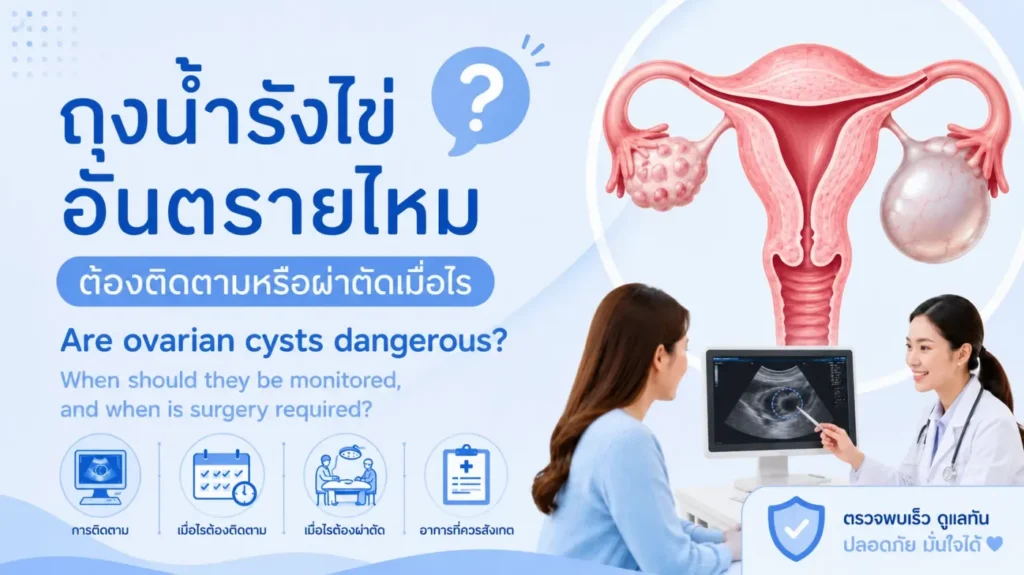
Ovarian Cysts: Are They Dangerous, and When Should They Be Monitored or Surgically Removed?
The term “ovarian cyst” can immediately cause concern for many women when it appears on an ultrasound report.
- Some are discovered incidentally during a routine health checkup.
- Some women seek medical attention because of pain on one side of the lower abdomen.
- Some experience abnormal menstrual periods.
- Some worry that the cyst may grow, rupture, twist, or become cancerous.

The good news is that “many ovarian cysts are not cancerous.” In women of reproductive age, certain cysts develop as part of the menstrual cycle and may disappear on their own without surgery. ACOG states that most ovarian cysts are benign, and many resolve without specific treatment.
However, not every ovarian cyst should simply be left without follow-up. Some cysts do not resolve spontaneously, some may bleed internally, some are endometriomas or “chocolate cysts,” and others are dermoid cysts. Some masses have complex features that need to be distinguished from ovarian tumors or ovarian cancer, particularly in postmenopausal women or those with concerning symptoms.
Therefore, the important question is not simply “Is there an ovarian cyst?” but also “What type of cyst is it? How large is it? What does it look like on ultrasound? Are there symptoms? And what is the patient’s age and menopausal status?” These factors help determine whether the cyst should be monitored, treated medically, or considered for surgery.
What Is an Ovarian Cyst?
An ovarian cyst is a sac containing fluid or semi-fluid material that develops within or on the surface of an ovary. Some cysts occur naturally as part of the menstrual cycle, some result from specific medical conditions, and some ovarian masses may not actually be simple cysts.
In women of reproductive age, the ovaries produce eggs and hormones. During each menstrual cycle, a follicle develops in preparation for ovulation. If the follicle does not rupture or fluid accumulates within it, a functional cyst may develop. These cysts are usually benign and often resolve spontaneously.
Other cysts are unrelated to the normal menstrual cycle, including endometriomas, dermoid cysts, and cystadenomas. These may require monitoring or treatment depending on their characteristics.
The ACOG Practice Bulletin on adnexal masses emphasizes that a key goal when evaluating an ovarian or adnexal mass is to distinguish benign lesions from those with a risk of malignancy and to determine whether the patient requires emergency surgery, planned surgery, or observation.
What Are the Common Types of Ovarian Cysts?
There are several types of ovarian cysts. Understanding the type helps explain why some cysts disappear spontaneously while others require monitoring or surgery.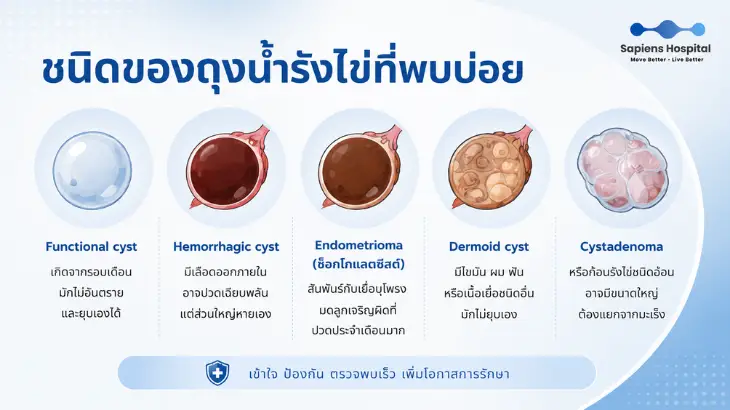
1. Functional cyst
These cysts are related to the menstrual cycle, such as follicular cysts and corpus luteum cysts. They are commonly found in women of reproductive age. Many cause no symptoms and are discovered incidentally. If there are no suspicious features, these cysts often resolve spontaneously within a few menstrual cycles.
2. Hemorrhagic cyst
This is a cyst in which bleeding occurs, often involving a corpus luteum cyst. A patient may develop sudden pain on one side of the lower abdomen. Some resolve spontaneously, but significant bleeding, severe pain, or suspected rupture may require close observation or urgent treatment.
3. Endometrioma or chocolate cyst
This type of cyst is associated with endometriosis. It commonly contains old blood with a chocolate-like appearance and may cause severe menstrual pain, chronic pelvic pain, pain during sexual intercourse, or infertility.
4. Dermoid cyst
A dermoid cyst is a usually benign ovarian tumor that may contain fat, hair, teeth, or other tissues. It can occur in younger women and women of reproductive age. Although most are not cancerous, larger cysts may increase the risk of ovarian torsion. Monitoring or surgery may therefore be considered depending on size and symptoms.
5. Cystadenoma
A cystadenoma is a cystic mass arising from ovarian tissue. It may become large and may contain clear fluid or mucus. Surgery may be considered if the mass becomes large, causes pressure on surrounding organs, or cannot be clearly distinguished from other types of ovarian masses.
6. Ovarian masses with complex features
If ultrasound shows a thick wall, multiple compartments, solid components, papillary projections, or increased blood flow, doctors will evaluate the mass more carefully because it may not be a simple cyst. ACR O-RADS is a system used to categorize the risk of ovarian masses based on ultrasound characteristics and to guide appropriate follow-up or referral.
What Are the Symptoms of an Ovarian Cyst?
Many ovarian cysts cause no symptoms and are discovered incidentally on ultrasound. When symptoms occur, they may include:
- * Pain on one side of the lower abdomen
- * Dull or aching pelvic pain
- * Abdominal bloating, pressure, or a feeling that the abdomen is enlarged
- * Pain during sexual intercourse
- * Increased menstrual pain
- * Abnormal menstrual periods in some patients
- * Frequent urination if the mass presses on the bladder
- * Difficulty with bowel movements if the mass presses on the bowel
- * Sudden pain if the cyst ruptures or ovarian torsion occurs
However, these symptoms cannot reliably identify the type of ovarian mass. Other pelvic conditions, including uterine fibroids, pelvic inflammatory disease, ureteral stones, and appendicitis, can cause similar lower abdominal pain.
Are Ovarian Cysts Dangerous?
The answer is: “It depends on the type, size, appearance of the mass, the patient’s age, and symptoms.”
Small cysts that are smooth, fluid-filled, without thick walls or solid components, particularly in women of reproductive age, are more likely to represent simple cysts and may be monitored with ultrasound as recommended by a doctor. Features that may require closer attention include:
- Large cysts
- Rapidly growing cysts
- Cysts with complex features
- Solid components within the mass
- Papillary projections
- Thick septations or multiple compartments
- Associated fluid in the abdomen
- Cysts found in postmenopausal women
- Severe or sudden pain
- A family history of ovarian or breast cancer
- Abnormal tumor markers together with suspicious imaging features
RCOG Green-top Guideline No. 62 states that evaluation of ovarian masses in premenopausal women should help distinguish patients who can be managed within general gynecology from those whose level of risk warrants referral to a gynecologic oncology team.
Emergency Warning Signs: Go to the Hospital Immediately
Some ovarian cysts can cause emergencies such as cyst rupture, internal bleeding, or ovarian torsion. Seek immediate medical attention if any of the following occurs:
- Sudden, severe lower abdominal pain
- Unusually severe pain on one side
- Severe nausea or vomiting together with lower abdominal pain
- Dizziness, fainting, palpitations, or pallor
- Abdominal pain accompanied by fever
- A rigid abdomen or severe abdominal tenderness
- Possible pregnancy or a missed period together with abdominal pain or bleeding
- Pain so severe that walking or moving becomes difficult
Ovarian torsion requires urgent treatment because reduced blood supply to the ovary can result in ovarian damage. ACOG notes that adnexal torsion in adolescents is often associated with benign ovarian masses such as functional cysts or benign teratomas, and suspected torsion requires urgent evaluation and treatment.
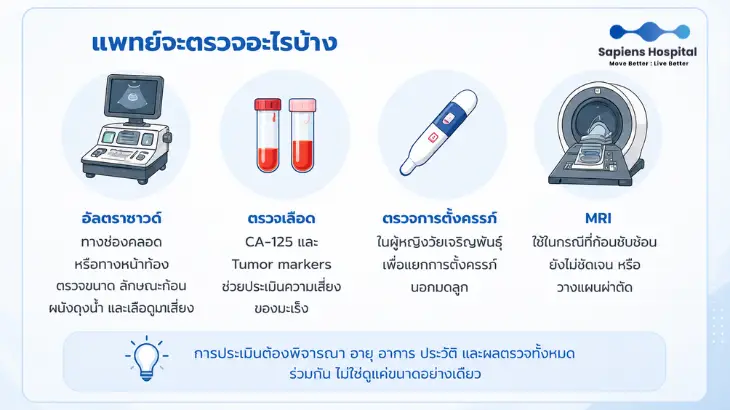
What Tests May Be Performed When an Ovarian Cyst Is Found?
Evaluation depends on age, symptoms, pregnancy history, individual risk, and the ultrasound characteristics of the mass.
1. Medical history and physical examination
The doctor may ask when the symptoms began, which side hurts, whether the pain is related to menstruation, whether menstrual periods are abnormal, and whether there is bloating, abdominal pressure, weight loss, frequent urination, or pain during sexual intercourse. A family history of ovarian and breast cancer is also important.
2. Pregnancy test
In women of reproductive age with lower abdominal pain or abnormal bleeding, pregnancy testing may be considered to help exclude ectopic pregnancy or pregnancy-related complications.
3. Transvaginal or transabdominal ultrasound
Ultrasound is the primary imaging examination for ovarian cysts. It helps assess the size, shape, cyst wall, number of compartments, solid components, blood flow, and other features that help distinguish a simple cyst from a mass requiring closer evaluation. O-RADS US was developed to standardize reporting and risk stratification of ovarian masses.
4. CA-125 and other tumor marker blood tests
CA-125 may be used as part of the assessment in selected patients, particularly when ovarian cancer is a concern or in postmenopausal women. However, CA-125 should not be interpreted in isolation because it can also be elevated in non-cancerous conditions such as endometriosis, inflammation, and uterine fibroids.
NICE recommends evaluation with CA-125 followed by ultrasound for women with symptoms suggestive of ovarian cancer. If ultrasound findings suggest ovarian cancer, appropriate referral to a gynecologic oncology service should be considered.
5. MRI
MRI is not necessary for everyone but may be useful when ultrasound findings are indeterminate, the mass is complex, further characterization is needed, or imaging is required for surgical planning. ACR O-RADS MRI provides a standardized approach to assessing the risk of adnexal masses on MRI and can help guide management.
When Is Follow-Up Appropriate?
Some ovarian cysts can be monitored with ultrasound without immediate surgery, particularly in women of reproductive age with a small simple or functional cyst and no concerning symptoms.
A doctor may schedule a repeat ultrasound after an appropriate interval, such as several weeks to a few months, depending on the size and characteristics of the cyst, to determine whether it has decreased, remained stable, or increased in size.
The SRU Consensus states that many simple adnexal cysts, particularly smooth cysts without suspicious characteristics, can be monitored according to size criteria and menopausal status without surgery in every case. Examples that may be monitored include:
- Small, simple-appearing cysts
- Functional cysts expected to resolve spontaneously
- Hemorrhagic cysts with mild symptoms and stable vital signs
- Small endometriomas with minimal symptoms
- Small asymptomatic dermoid cysts
- Masses with reassuring characteristics that still require monitoring for growth or change
However, follow-up should be performed according to a plan established by a doctor rather than simply “forgetting about the cyst.” If the mass does not resolve, grows, or changes in appearance, the treatment plan may need to be reconsidered.
When Is Surgery Needed?
Not every ovarian cyst requires surgery. Surgery may be considered when one or more of the following circumstances are present.
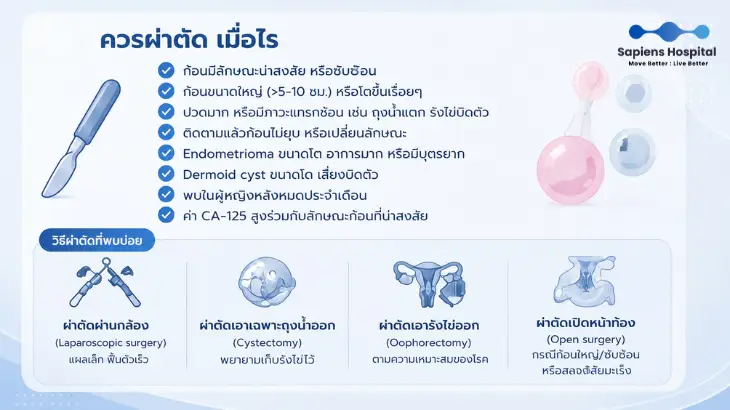
1. The mass has suspicious characteristics
Examples include solid components, thick walls, papillary projections, complex multilocular features, increased blood flow, or associated abdominal fluid. These masses should be evaluated systematically, and some patients should be referred to a gynecologic oncologist.
2. The mass is large or continues to grow
An enlarging cyst may compress surrounding organs, increase the risk of torsion, or become more difficult to characterize. There is no single size threshold requiring surgery for every patient, but a large or progressively enlarging mass warrants careful evaluation.
An AAFP review published in 2023 noted that adnexal masses larger than 10 cm, those containing solid components, or those demonstrating high blood flow on Doppler ultrasound are associated with higher risk and warrant further evaluation.
3. Severe pain or complications occur
A ruptured cyst with significant bleeding, ovarian torsion, or sudden severe pain may require emergency surgery or other urgent treatment.
4. The cyst does not resolve during follow-up
Many functional cysts are expected to resolve spontaneously. If follow-up shows that the cyst persists, enlarges, or changes in appearance, additional treatment may be considered.
5. An endometrioma or dermoid cyst causes symptoms or reaches a size that warrants treatment
If an endometrioma causes significant pain, is associated with infertility, or grows, specialist treatment may be considered. Some dermoid cysts may be surgically removed because they generally do not resolve like functional cysts and larger masses may increase the risk of torsion.
6. The mass occurs after menopause and has concerning features
In postmenopausal women, ovarian masses require more careful assessment because the likelihood of a non-functional or malignant ovarian mass increases with age. Evaluation may include ultrasound, CA-125, risk assessment, and appropriate referral.
What Types of Surgery Are Used for Ovarian Cysts?
The surgical approach depends on the type, size, and location of the mass, the patient’s age and fertility goals, and the estimated risk of malignancy.
1. Cystectomy
Cystectomy removes the cyst or mass while attempting to preserve healthy ovarian tissue. When clinically appropriate, it may be suitable for women of reproductive age who wish to preserve ovarian function and fertility.
2. Oophorectomy
Oophorectomy involves removal of one or both ovaries depending on the condition and clinical need. It may be considered in certain circumstances, such as a suspicious mass, older age, inability to safely separate the mass from the ovary, or suspected cancer.
3. Laparoscopic surgery
Laparoscopic surgery is commonly used for appropriately selected masses assessed as having a low risk of malignancy. It involves smaller incisions and may result in less postoperative pain and faster recovery for many patients. If cancer is suspected or the mass is very large, however, the surgeon may select another approach considered safer and more appropriate.
4. Open surgery
Open surgery may be used in selected circumstances, such as a very large mass, extensive adhesions, complications, or suspected cancer. Surgical planning aims to minimize unintended rupture of the mass and allow appropriate management of the underlying disease.
Ovarian Cysts and Fertility
Some ovarian cysts do not affect fertility. Others, such as endometriomas, may be associated with endometriosis and infertility. Decisions about ovarian surgery in women who still wish to become pregnant require careful consideration because ovarian surgery may affect ovarian reserve in some patients.
Therefore, if you are planning a future pregnancy, tell your doctor from the beginning so that management can be tailored to your reproductive goals.
Do Ovarian Cysts Require More Attention After Menopause?
In general, ovarian cysts require more careful assessment after menopause than during the reproductive years because functional cysts related to the menstrual cycle should occur less frequently, while the risk of malignant ovarian masses increases with age.
This does not mean that every ovarian cyst after menopause is cancerous. A small, smooth, simple cyst without symptoms may sometimes be monitored according to appropriate criteria. Nevertheless, detailed ultrasound assessment, CA-125 testing, and evaluation of other risk factors may be appropriate.
How Should You Care for Yourself After Being Diagnosed with an Ovarian Cyst?
If your doctor recommends monitoring rather than immediate surgery, you should:
- Attend scheduled ultrasound follow-up appointments
- Monitor lower abdominal or pelvic pain
- Seek immediate medical attention if severe sudden pain occurs
- Keep track of your menstrual cycle and abnormal symptoms
- Tell your doctor if you develop abnormal periods, spotting, or worsening pain
- Do not take hormones or herbal medicines on your own without medical advice
- Tell your doctor if you are planning a pregnancy
- Continue follow-up according to the treatment plan and do not discontinue monitoring while the mass remains present
Frequently Asked Questions
1. Is an ovarian cyst cancer?
Most ovarian cysts are not cancerous, particularly simple-appearing cysts in women of reproductive age. However, masses that are complex, rapidly growing, contain solid components, or occur after menopause should be evaluated more carefully.
2. Can an ovarian cyst disappear on its own?
Many functional cysts can resolve spontaneously within a few menstrual cycles. Other cysts, such as dermoid cysts and endometriomas, generally do not disappear in the same way and may require monitoring or treatment.
3. What size ovarian cyst requires surgery?
There is no single size threshold that applies to everyone. Doctors consider size, ultrasound characteristics, symptoms, age, and overall risk. Surgery may be considered if the mass is large, continues to grow, has complex features, or causes significant pain.
4. Does a high CA-125 level mean ovarian cancer?
Not necessarily. CA-125 may also be elevated in endometriosis, inflammation, uterine fibroids, and other non-cancerous conditions. Results must be interpreted together with age, symptoms, ultrasound findings, and overall risk.
5. Is a ruptured ovarian cyst dangerous?
Some patients experience pain that subsequently improves without intervention. However, if rupture causes significant bleeding, severe pain, dizziness, fainting, or a rapid pulse may occur and immediate hospital assessment is required.
6. What are the symptoms of ovarian torsion?
Ovarian torsion often causes sudden, severe pain on one side of the lower abdomen and may be accompanied by nausea and vomiting. It is a medical emergency requiring prompt treatment to reduce the risk of ovarian damage.
7. Does ovarian cyst surgery always require removal of the ovary?
No. When appropriate, the surgeon may remove only the cyst while preserving the ovary. However, removal of an ovary may need to be considered if the ovary is severely damaged, the mass has concerning characteristics, or other clinical indications are present.
Ovarian cysts are common, and most are not cancerous. This is particularly true of cysts related to the menstrual cycle in women of reproductive age. Many can be monitored with ultrasound and may resolve spontaneously.
Some ovarian cysts, however, require monitoring or treatment, including large or rapidly growing cysts, complex masses, cysts causing significant pain, cysts that persist during follow-up, or ovarian cysts detected after menopause. Particular attention is required when a mass contains solid components, thick walls, papillary projections, associated abdominal fluid, or abnormal blood test findings.
If you experience sudden severe lower abdominal pain, marked one-sided pain, nausea or vomiting, dizziness, fainting, or possible pregnancy accompanied by abdominal pain, seek immediate medical attention because these symptoms may indicate a ruptured cyst, ovarian torsion, or another emergency condition.
The best approach to an ovarian cyst is not to panic, but also not to ignore it. Obtain an appropriate evaluation, follow the recommended monitoring plan, and receive treatment when clinically indicated.
For Information and Appointments
Sapiens Hospital Move Better : Live Better
Tel. 02-111-3703
References
1. American College of Obstetricians and Gynecologists.Evaluation and Management of Adnexal Masses. Practice Bulletin.
2. American College of Obstetricians and Gynecologists. Ovarian Cysts. Patient FAQ.
3. Andreotti RF, et al. O-RADS US Risk Stratification and Management System: A Consensus Guideline from the ACR Ovarian-Adnexal Reporting and Data System Committee. Radiology. 2020.
4. Strachowski LM, et al. O-RADS US v2022: An Update from the American College of Radiology’s Ovarian-Adnexal Reporting and Data System Ultrasound Committee. Radiology. 2023.
5. Levine D, et al. Simple Adnexal Cysts: SRU Consensus Conference Update on Follow-up and Reporting. Radiology.2019.
6. Royal College of Obstetricians and Gynaecologists.Management of Suspected Ovarian Masses in Premenopausal Women. Green-top Guideline No. 62.
7. National Institute for Health and Care Excellence. **Ovarian cancer: recognition and initial management / suspected cancer referral guidance.
8. Wheeler V, et al. Adnexal Masses: Diagnosis and Management.American Family Physician.2023.