
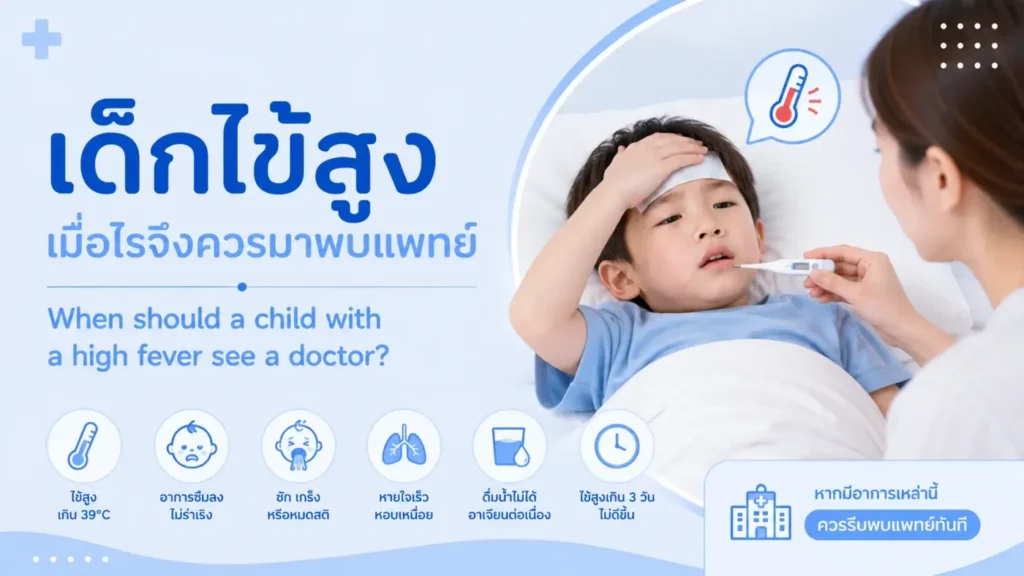
High Fever in Children: When Should You Take Your Child to See a Doctor?
When your child feels very hot, develops a high fever, looks pale, becomes unusually drowsy, or is more irritable than usual, it is natural for parents to become concerned. Common questions include, “Do we need to go to the hospital right away?”, “How high is too high?”, or “Can I give fever-reducing medicine and monitor my child at home?”
Most fevers in children are caused by viral infections and often improve on their own. However, in some children, fever can be an early sign of a condition requiring prompt medical evaluation, such as sepsis, pneumonia, meningitis, urinary tract infection, dengue fever, or Kawasaki disease, particularly in very young children, whose symptoms may initially be subtle.
International guidelines such as the NICE guideline from the United Kingdom recommend assessing a child with fever based on the “risk of serious illness” rather than temperature alone. Assessment includes the child’s skin color, responsiveness, breathing, hydration status, neurological symptoms, and age.
What Is a Fever, and What Temperature Is Considered a Fever?
In general, a temperature of 38°C or higher is considered a fever in children. Temperature should be measured using an age-appropriate, reliable thermometer. For very young infants, both measurement and interpretation require particular care because even a temperature that does not appear extremely high may be medically significant.
What parents should understand is that fever is the body’s response to infection or inflammation; it is not a disease itself. The goal of care is therefore not simply to bring the temperature down as quickly as possible, but to determine whether the child appears well, can drink fluids, is breathing normally, remains responsive or active, and has any warning signs.
With Fever in Children, Associated Symptoms Matter More Than the Number Alone
Some children may have a temperature of 39°C but become active again after fever medicine, drink normally, breathe comfortably, and look well. They may sometimes be monitored closely at home for a short period. Another child may have a temperature of only 38.3°C but be extremely drowsy, difficult to wake, short of breath, have bluish lips, cold hands and feet, or significantly reduced urination. The second situation is clearly more concerning.
NICE advises that in children older than 6 months, temperature alone should not be used to determine whether a serious illness is present. All clinical signs should be considered together. In contrast, infants younger than 3 months with a temperature of 38°C or higher are considered at higher risk of serious illness. Children aged 3–6 months with a temperature of 39°C or higher are considered to be at least at intermediate risk and should be carefully assessed.
Infants Younger Than 3 Months With Fever Should Be Evaluated by a Doctor
If your baby is younger than 3 months and has a temperature of 38°C or higher, medical assessment should be sought promptly rather than waiting for symptoms to develop, even if the baby does not appear very unwell. Serious infections in young infants can initially cause only subtle symptoms such as reduced feeding, unusual irritability, unusually high or low body temperature, rapid breathing, or increasing drowsiness.
Guidance from the American Academy of Pediatrics for febrile infants aged 8–60 days emphasizes systematic evaluation according to age because the risk of serious bacterial infection differs from that of older children. Depending on the infant’s age and clinical condition, blood tests, urine tests, or other investigations may be required at the physician’s discretion.
For parents, the key message is simple: if your baby is very young, particularly under 3 months of age, do not rely only on outward appearance. Early medical evaluation is generally the safer approach.
Warning Signs That Require Immediate Medical Attention
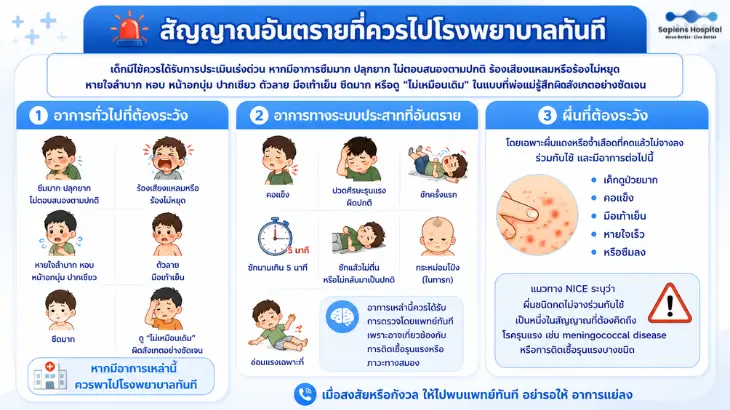
A child with fever requires urgent medical assessment if they are extremely drowsy, difficult to wake, less responsive than usual, crying continuously or unusually, having difficulty breathing, breathing very rapidly, showing chest retractions, developing bluish lips, mottled skin, cold hands and feet, marked paleness, or appearing clearly “not themselves.”
Neurological symptoms are also important warning signs. These include neck stiffness, unusually severe headache, a first seizure, a seizure lasting longer than 5 minutes, failure to wake or return to normal after a seizure, a bulging fontanelle in an infant, or focal weakness. These symptoms require immediate medical assessment because they may be associated with serious infection or neurological conditions.
Rashes also require attention, particularly a red or purple rash that does not fade when pressed, especially when accompanied by fever, severe illness, neck stiffness, cold hands and feet, rapid breathing, or increasing drowsiness. NICE identifies a non-blanching rash with fever as an important warning sign for potentially serious illnesses, including meningococcal disease.
Fever With Poor Fluid Intake or Reduced Urination: Watch for Dehydration
Children with fever commonly lose their appetite. More concerning than eating less is being unable to drink fluids or having significantly reduced urination. Fever increases fluid loss, particularly when accompanied by vomiting or diarrhea. Signs of dehydration include a very dry mouth, no tears when crying, sunken eyes, unusual thirst, increasing drowsiness, cold hands and feet, reduced urination, or diapers remaining dry for longer than usual.
Signs of severe dehydration in children may include marked drowsiness or altered consciousness, cold extremities, poor circulation, and delayed capillary refill. These require urgent medical attention. If your child has fever and vomits whenever they drink, cannot keep medicine down, has severe diarrhea, or continues to urinate much less than usual, medical assessment is recommended because young children can become dehydrated more quickly than adults.
If Fever Persists for More Than 2 Days Without Improvement, Consider Medical Evaluation
If your child’s fever continues for more than 48 hours without improvement, or the child’s overall condition is worsening, medical assessment is appropriate even if there are no obvious emergency warning signs. Some illnesses may initially resemble a common viral infection before more specific symptoms appear, including pneumonia, middle-ear infection, urinary tract infection, influenza, dengue fever, or certain bacterial infections.
The Royal Children’s Hospital Melbourne recommends medical assessment when a child younger than 3 months has a fever, appears increasingly unwell, is not improving after 2 days, is vomiting and unable to drink, develops a rash, has difficulty breathing, becomes increasingly drowsy, or when parents are concerned that the child does not seem normal.
Fever Lasting 5 Days or Longer Should Not Be Ignored
A child with fever lasting 5 days or longer should be medically assessed, even if the fever occasionally decreases. Conditions requiring specific evaluation include Kawasaki disease, which may cause fever together with red eyes, red or cracked lips, a strawberry-like tongue, rash, swollen or red hands and feet, and enlarged lymph nodes. Young children may not show all of these features.
NICE recommends considering Kawasaki disease in children with fever lasting 5 days or longer. Children younger than 1 year may have fewer typical clinical features but can have a higher risk of coronary artery abnormalities than older children.
In Thailand, Dengue Fever Must Also Be Considered
In Thailand, a child with sudden high fever, particularly persistent fever for several days accompanied by headache, body aches, poor appetite, nausea, vomiting, abdominal pain, or rash, should also be evaluated for possible dengue when clinically appropriate. Importantly, severe dengue warning signs can sometimes emerge as the fever begins to subside rather than when the temperature is at its highest.
Warning signs of severe dengue include severe abdominal pain, persistent vomiting, rapid breathing, bleeding from the gums or nose, marked fatigue or restlessness, blood in vomit or stool, excessive thirst, cold or pale skin, or profound weakness. These symptoms require urgent medical attention.
If dengue is suspected, avoid self-medicating with aspirin or NSAIDs such as ibuprofen unless specifically advised by a healthcare professional, because these medicines may increase bleeding risk. Fever medicine should be used according to appropriate medical advice while the child’s symptoms are monitored closely.
Should You Worry If Fever Does Not Come Down After Medicine?
Fever-reducing medicine does not always make the temperature return to normal immediately. Its main purpose is to improve the child’s comfort, help them drink and rest, and reduce discomfort associated with fever. If the temperature remains elevated but the child becomes more alert, drinks fluids, breathes normally, and responds appropriately, the temperature alone may not indicate an emergency.
The Royal Children’s Hospital Melbourne advises that paracetamol or ibuprofen may be used when fever is making a child uncomfortable, according to age, weight, contraindications, and appropriate dosing advice. Aspirin should not be given to children unless specifically prescribed by a doctor. Cold baths or very cold sponging are also not recommended because they can cause shivering and additional discomfort.
However, if your child becomes increasingly drowsy, has difficulty breathing, cannot drink, vomits repeatedly, urinates less, develops cold hands and feet or an unusual rash, or you feel that this is “more than an ordinary fever,” seek medical assessment without waiting.
What Should You Do If Your Child Has a Febrile Seizure?
Febrile seizures occur in some children and can be frightening for parents. Most simple febrile seizures do not cause long-term problems. However, urgent medical attention is required for a first seizure, a seizure lasting longer than 5 minutes, failure to wake or return to normal afterward, repeated seizures during the same illness, or a seizure accompanied by neck stiffness, marked drowsiness, or abnormal breathing.
During a seizure, place the child on their side in a safe area and move hard or sharp objects away. Do not force anything into the child’s mouth and do not give food, water, or medicine during the seizure. Time the seizure. If it lasts longer than 5 minutes or the child has abnormal breathing, seek emergency medical assistance immediately.
When Can a Child Be Temporarily Cared for at Home?
A child older than 6 months who has fever but can still drink, urinates normally, breathes comfortably, has no concerning rash or neck stiffness, is not excessively drowsy, and remains interactive when the fever improves may sometimes be monitored closely at home initially. Offer fluids frequently, allow adequate rest, use comfortable clothing, and give fever-reducing medicine according to the child’s weight and appropriate medical or label instructions. Avoid giving antibiotics without medical advice because many childhood fevers are caused by viruses, which do not respond to antibiotics.
However, “can be cared for at home” does not mean that no monitoring is necessary. Parents should regularly observe breathing, skin color, alertness, fluid intake, urination, rash, vomiting, and the child’s behavior when the fever decreases. If the condition worsens, seek medical attention promptly.
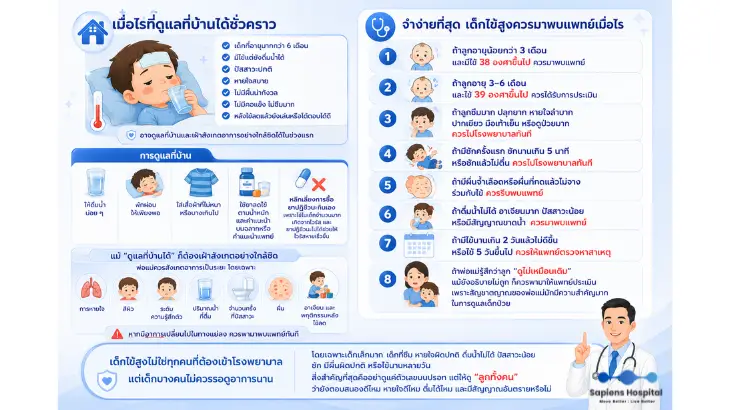
- Easy guide: When should a child with fever see a doctor?
- If your child is younger than 3 months and has a temperature of 38°C or higher, seek medical assessment promptly.
- If your child is 3–6 months old and has a temperature of 39°C or higher, medical assessment is recommended.
- If your child is extremely drowsy, difficult to wake, has difficulty breathing, bluish lips, cold hands and feet, or appears very unwell, go to the hospital immediately.
- If your child has a first seizure, a seizure lasting longer than 5 minutes, or does not regain normal consciousness afterward, seek emergency medical care immediately.
- If fever is accompanied by a purple or non-blanching rash, seek urgent medical attention.
- If your child cannot drink, vomits repeatedly, urinates much less than usual, or shows signs of dehydration, seek medical assessment.
- If fever continues for more than 2 days without improvement, or lasts 5 days or longer, the child should be assessed to determine the cause.
- If you feel that your child is “not themselves,” even if you cannot clearly explain why, consider medical evaluation. A parent’s observation of a meaningful change in their child’s condition can be important.
Not every child with a high fever needs hospital treatment, but some children should not be observed at home for too long, particularly very young infants. Marked drowsiness, abnormal breathing, inability to drink, reduced urination, seizures, unusual rash, or prolonged fever are important warning signs. Most importantly, do not focus only on the number on the thermometer. Look at the whole child: Are they responsive? Are they breathing comfortably? Can they drink? Are there any warning signs?
For parents who are unsure whether to continue monitoring at home or seek medical attention, having the child assessed is appropriate, particularly for very young children or when symptoms are changing rapidly. Some serious infections can progress quickly, and timely evaluation can be important.
Sapiens Hospital
Move Better:Live Better
Tel. 02-111-3703
References
National Institute for Health and Care Excellence. Fever in under 5s: assessment and initial management. NICE Guideline NG143. 2021. Pantell RH, Roberts KB, Adams WG, et al. Evaluation and Management of Well-Appearing Febrile
Infants 8 to 60 Days Old. Pediatrics. 2021;148(2):e2021052228.
The Royal Children’s Hospital Melbourne. Clinical Practice Guidelines: Febrile child.
The Royal Children’s Hospital Melbourne. Kids Health Info: Fever in children.
Centers for Disease Control and Prevention. Oral Rehydration, Maintenance, and Nutritional
Therapy: The Management of Acute Diarrhea in Children.
World Health Organization. Dengue and severe dengue: fact sheet.