
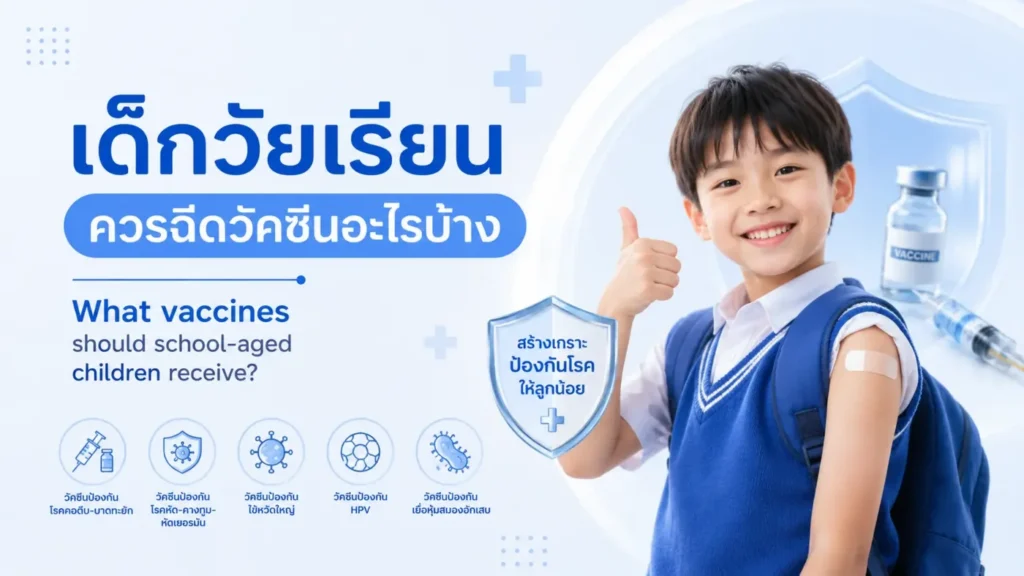
What Vaccines Should School-Age Children Receive?
When children start school, their world immediately becomes much bigger. Instead of spending most of their time at home and meeting only a few people, they begin sharing daily life with dozens of classmates—eating together, playing sports, using shared bathrooms and playgrounds, and sometimes exchanging toys or snacks without even realizing it. School is therefore not only a place for learning; it is also an environment where many infectious diseases can spread more easily than at home.
Many parents believe that “vaccines are only for young children.” Once their child has passed kindergarten age, they may assume that all vaccinations are complete. In reality, school-age children and adolescents may still need booster doses, catch-up vaccinations, or additional vaccines depending on their age, underlying health conditions, lifestyle, travel, and individual risk factors.
The World Health Organization states that vaccines are among the major achievements of global public health. Vaccines can prevent more than 30 dangerous diseases, and immunization helps prevent approximately 3.5–5 million deaths each year from diseases such as diphtheria, tetanus, pertussis, influenza, and measles.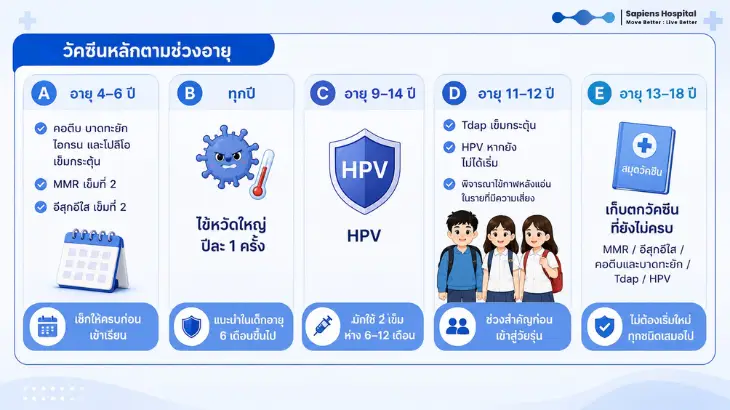
Why do school-age children still need their vaccination records reviewed?
The first reason is that immunity from some vaccines decreases over time, making booster doses necessary, such as vaccines against diphtheria, tetanus, and pertussis. Second, some diseases are best prevented before adolescence, such as HPV infection, for which vaccination is ideally given before potential exposure to the virus. Third, some children may not have completed their vaccinations when they were younger because of illness, postponed appointments, moving schools or countries, or uncertainty about how many doses they previously received.
CDC recommends that clinicians assess childhood vaccination according to age, review the catch-up schedule when vaccinations are incomplete, consider additional vaccines based on underlying medical conditions or specific indications, and review contraindications and precautions before vaccination.
In Thailand, parents should refer to the child’s vaccination record, Thailand’s national immunization schedule, and the latest recommendations from the Pediatric Infectious Disease Society of Thailand. The 2026 Thai child and adolescent immunization schedule should be used together with an individualized assessment by a pediatrician.
Basic vaccines that school-age children should check
When considering vaccines for school-age children, the first step is not to start with newly available vaccines. Instead, parents should open their child’s existing vaccination record and check whether all routine vaccines from infancy through the preschool years have been completed. Many vaccines need to be given as a complete series. Missing one or two doses may result in incomplete protection against disease.
Vaccines that should be reviewed in school-age children include vaccines against diphtheria, tetanus, pertussis, polio, measles, mumps, rubella, and chickenpox, as well as hepatitis B, hepatitis A, Japanese encephalitis, influenza, HPV, and other vaccines based on individual risk such as pneumococcal, meningococcal, COVID-19, or travel vaccines. Not every child needs all of these vaccines at the same time. Vaccination should be assessed according to the child’s age, previous vaccination history, health status, and individual risk factors.
For children in Thailand, an important reference is the “Recommended Immunization Schedule for Thai Children and Adolescents 2026 by the Pediatric Infectious Disease Society of Thailand,” which is the latest schedule published in 2026 and should be used together with the clinical judgment of the pediatrician or physician caring for each child.
1. Diphtheria, Tetanus, Pertussis, and Polio Vaccines
Vaccines against diphtheria, tetanus, pertussis, and polio are routine childhood vaccines that should be given from an early age, with booster doses commonly scheduled before school entry or during the early school years. Their purpose is not only to protect the individual child but also to help reduce transmission within schools. Pertussis is particularly important because in older children it may resemble an ordinary persistent cough, yet the infection can be especially dangerous to young infants at home.
According to CDC guidance, the routine DTaP series consists of 5 doses, including a booster at 4–6 years of age. During adolescence, Tdap is used as a booster and is routinely recommended at 11–12 years of age. Adolescents aged 13–18 years who have never received Tdap should receive 1 dose as a booster.
In practice, if it is unclear whether a school-age child has completed these vaccinations, the physician will review the previous vaccination record and develop a catch-up plan. Vaccination should not simply be overlooked because the child is older, as some vaccine-preventable diseases can return when community immunity declines.
2. Measles, Mumps, and Rubella Vaccine
The MMR vaccine is particularly important for school-age children because measles is highly contagious and can spread easily in classrooms. It can also cause complications such as pneumonia, middle ear infection, encephalitis, and, rarely, a severe neurological disease that may occur years after infection.
Children should receive 2 doses of MMR vaccine. If a child has never received the vaccine or it is unclear whether the series was completed, a physician should assess the need for catch-up vaccination. CDC guidance recommends a 2-dose MMR series, routinely given at 12–15 months and 4–6 years of age. Children and adolescents who have not previously been vaccinated generally require 2 doses separated by at least 4 weeks.
Many families may think measles is an old disease that is rarely seen anymore. In reality, measles outbreaks can return when vaccination coverage declines. Schools are therefore environments where maintaining protection against measles is especially important.
3. Chickenpox (Varicella) Vaccine
Most children with chickenpox recover without serious problems, but the disease should not always be considered harmless. Some children may develop complications such as secondary bacterial skin infections, pneumonia, encephalitis, or severe illness, particularly those with weakened immune systems. Children with chickenpox may also need to stay away from school for several days and can transmit the infection to high-risk household members such as pregnant women, infants, or people with weakened immune systems.
CDC guidance recommends a 2-dose varicella vaccine series, routinely given at 12–15 months and 4–6 years of age. Children and adolescents aged 7–18 years without evidence of immunity should receive 2 catch-up doses, with the interval between doses depending on the child’s age.
Some Thai children who have previously had chickenpox may not need vaccination again. However, a physician should assess whether there is a reliable history of previous infection or whether immunity testing may be appropriate in selected situations.
4. Influenza Vaccine
Influenza is not simply a common cold. School-age children can become infected easily, spread the virus readily, and bring the infection home to family members. Some children develop high fever, significant body aches, severe cough, and fatigue lasting several days. Complications may include pneumonia, asthma exacerbation, febrile seizures, or other problems, particularly among younger children and children with lung disease, heart disease, neurological conditions, blood disorders, weakened immunity, or other chronic illnesses. Influenza vaccination should be considered every year because circulating influenza viruses can change and immunity from vaccination decreases over time.
CDC guidance recommends that children aged 6 months and older receive an age- and health-appropriate influenza vaccine every year. Children aged 6 months through 8 years who have never previously received influenza vaccination or whose vaccination history is uncertain may need 2 doses during their first vaccination season, separated by at least 4 weeks. Children aged 9 years and older generally receive 1 dose each year.
In Thailand, where influenza can occur throughout the year with periodic seasonal increases, annual vaccination before anticipated periods of increased transmission should be considered, particularly for children attending school, spending extended time in air-conditioned classrooms, or living with underlying medical conditions.
5. HPV Vaccine
Many parents hesitate about HPV vaccination because they feel it is not yet relevant to school-age children. In fact, the vaccine is most effective as a preventive measure when given before potential exposure to HPV, making the pre-adolescent period an appropriate time to consider vaccination rather than waiting until the child is older.
HPV is associated with cervical cancer, anal cancer, certain cancers of the mouth and throat, and genital warts. The vaccine therefore benefits both girls and boys, not only girls. CDC recommends routine HPV vaccination at 11–12 years of age, and vaccination can begin at age 9. When the series is started at ages 9–14 years, it is generally given as 2 doses at 0 and 6–12 months. If vaccination begins at age 15 years or older, or if the child is immunocompromised, a 3-dose schedule is generally used.
From the perspective of long-term disease prevention, HPV vaccination is particularly valuable because it helps prevent disease before it develops rather than waiting until abnormalities appear and then beginning investigation or treatment. Parents should therefore discuss HPV vaccination with a physician when their child reaches the later primary-school or early secondary-school years.
6. Hepatitis B and Hepatitis A Vaccines
Hepatitis B vaccine is a routine vaccine that most Thai children receive beginning at birth. However, children without vaccination records, those who have moved from another country, or those who did not complete the vaccination series should have their history carefully reviewed because hepatitis B virus can cause chronic infection, cirrhosis, and liver cancer later in life.
Hepatitis A vaccination should also be considered for school-age children, particularly those who travel frequently, regularly eat outside the home, live or travel in areas where food and water sanitation may be uncertain, or whose families wish to reduce the risk of infection transmitted through contaminated food and water. Although many children recover from hepatitis A, the infection can cause fever, fatigue, nausea, abdominal pain, jaundice, and prolonged absence from school or recovery time.
7. Japanese Encephalitis Vaccine
In Thailand, Japanese encephalitis vaccination is important because the disease occurs in Asia and is transmitted by mosquitoes. Although the number of cases has declined substantially following vaccination programs, infection can be severe and may cause encephalitis, seizures, neurological disability, or death. School-age children who have not completed the recommended vaccination schedule should be assessed for catch-up vaccination according to Thailand’s immunization recommendations.
Parents should not assume that Japanese encephalitis is only a concern in rural areas. Children may travel to other provinces, visit family, attend camps, or participate in outdoor activities in areas where exposure may occur. Reviewing the vaccination record can therefore help reduce uncertainty before travel or outdoor activities.
8. COVID-19 Vaccine
COVID-19 is generally less severe in most children than in adults, but some children remain at increased risk, including those with obesity, lung disease, heart disease, weakened immunity, neurological disorders, or other chronic conditions. School-age children may also transmit infection to older adults or family members with chronic illnesses at home.
Because recommendations for COVID-19 vaccination may change according to circulating variants, available vaccines, and public health policies, decisions should follow current recommendations in Thailand and be discussed with a physician, particularly for children with underlying medical conditions or those living with high-risk household members. Vaccination decisions should take into account the individual child’s health status, previous vaccination and infection history, and current public health recommendations.
9. Pneumococcal Vaccine
Pneumococcal vaccines help reduce the risk of diseases caused by Streptococcus pneumoniae, including pneumonia, meningitis, bloodstream infections, and some middle ear infections. Many children receive pneumococcal vaccination during infancy, but additional vaccination may be considered for certain school-age children, particularly those with underlying conditions such as heart disease, lung disease, kidney disease, liver disease, diabetes, immunodeficiency, absence or dysfunction of the spleen, or treatment with immunosuppressive medications.
Recommendations for additional pneumococcal vaccination in children and adolescents at increased risk depend on the child’s previous pneumococcal vaccination history, the type of PCV previously received, and the individual medical condition.
10. Meningococcal Vaccine
Meningococcal vaccination may not be a routine vaccine for every Thai child in the same way it is routinely recommended for adolescents in some countries. However, it should be considered for children with specific risks, such as those planning to study abroad, live in dormitories, travel to areas experiencing outbreaks, travel for Hajj, or have medical conditions that increase their risk, including absence of the spleen, certain immune system disorders, or the use of certain medications.
In the United States, CDC recommends MenACWY routinely at age 11–12 years, followed by a booster at age 16 years. Special recommendations also apply to travelers visiting areas where meningococcal disease is common, such as the African meningitis belt or during Hajj, and to people with certain medical risk factors.
For Thai children planning to study abroad, particularly at boarding schools, universities, dormitories, or in countries that require specific vaccinations before enrollment, parents should consult a physician at least 1–2 months in advance to allow sufficient time to arrange vaccinations and the necessary documentation.
Children who have missed vaccines do not always need to restart the entire series
A common concern among parents is whether a child who has missed vaccinations for several years must restart the vaccination series from the beginning. In general, the answer is “usually not.” Physicians use catch-up vaccination principles to determine which vaccines the child has already received, which doses are missing, and how to complete the remaining doses using appropriate intervals.
Catch-up vaccination guidance generally indicates that a vaccine series does not need to be restarted regardless of how much time has elapsed between doses. Instead, the catch-up schedule, minimum intervals between doses, and recommendations for each vaccine should be followed.
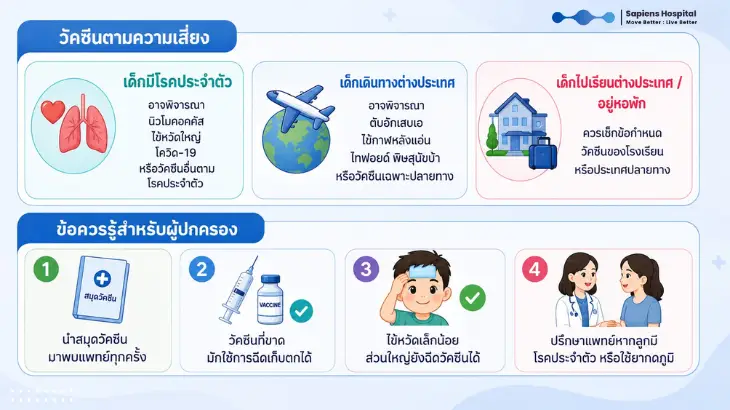
This is why vaccination records are so valuable. Parents should consider keeping a photograph or digital copy on their phone and bring the original record whenever the child sees a physician. Having an accurate vaccination history helps avoid unnecessary repeat doses and allows vaccination planning to be more precise.
Children with underlying medical conditions need individualized vaccination plans
Some children require more detailed vaccination planning than healthy children, including children with asthma, heart disease, kidney disease, liver disease, diabetes, blood disorders, immunodeficiency, absence of the spleen, children receiving high-dose steroids, immunosuppressive drugs or biologic therapies, and children undergoing cancer treatment.
These children may need certain vaccines more than healthy children, such as influenza or pneumococcal vaccines and other vaccines depending on their medical condition. At the same time, some live vaccines may need to be avoided or postponed in children with significant immunosuppression. Before vaccination, physicians should review age-appropriate vaccines, vaccines indicated by underlying medical conditions or other specific risks, and any contraindications or precautions.
Vaccines Before Travel
School-age children traveling internationally should always have their vaccination status reviewed before departure, whether they are taking a family trip, attending a summer program, joining a sports camp, or moving abroad for school. Disease risks differ between destinations, and some travelers may need to consider vaccines against typhoid, meningococcal disease, yellow fever, hepatitis A, hepatitis B, rabies, or other diseases depending on their destination.
For children traveling to areas where measles is a concern, children aged 12 months and older who have not been vaccinated should generally receive 2 doses of MMR separated by at least 4 weeks before travel. Children who have already received 1 dose should receive the second dose at an appropriate interval before departure.
Pre-travel medical consultation should be arranged in advance because many vaccines require time for the body to develop immunity, and some require more than one dose. Seeking advice too close to the departure date may reduce the opportunity to obtain full protection.
Common Side Effects After Vaccination
Most vaccine side effects are mild, such as pain, swelling, or redness at the injection site, low-grade fever, tiredness, irritability, or mild body aches. These symptoms usually improve within 1–2 days. Applying a cold compress during the first day, gently moving the arm, resting, drinking adequate fluids, and using an appropriate weight-based fever-reducing medicine when necessary may help the child feel more comfortable.
Symptoms requiring prompt medical attention include difficulty breathing, swelling of the face or lips, widespread hives, severe dizziness, fainting, unusual drowsiness, seizures, or very high fever after vaccination. Although severe allergic reactions are very rare, vaccination facilities should have appropriate post-vaccination observation procedures and emergency equipment in accordance with established standards.
Can several vaccines be given at the same visit?
Many vaccines can be administered during the same visit when there are no contraindications. They are given at different injection sites and documented clearly. Giving vaccines at the same visit can reduce the number of hospital visits, lower the chance of missed appointments, and allow children to receive protection sooner. However, the physician will consider the child’s age, vaccine types, medical history, allergy history, and health status on the day of vaccination.
Some parents worry that receiving several vaccines at once may overload the immune system. In everyday life, however, children are exposed to numerous microorganisms and foreign substances. Vaccines stimulate the immune system in a controlled way so that the body can recognize specific pathogens before encountering the actual disease. WHO explains that vaccines work with the body’s natural immune defenses to build protection and are an important tool for preventing infectious diseases and controlling outbreaks.
Frequently Asked Questions from Parents
- My child is older now, but I am not sure whether all vaccinations were completed. What should I do?
Bring the child’s vaccination record to a physician for review. If there is no record or the information is unclear, the physician may develop a catch-up vaccination plan or
consider immunity testing for selected diseases when appropriate. Parents should not simply guess or ignore the issue because some vaccines require
a complete series to provide optimal protection. - My child has a mild cold. Can they still be vaccinated?
In general, a mild cold without high fever, unusual drowsiness, or significant illness usually does not prevent vaccination. However, if the child has a high fever,
significant fatigue, breathing difficulty, severe vomiting, or an unstable acute illness, a physician should assess the child first. Some vaccines may be
postponed until the child’s condition improves. - Is the HPV vaccine only for girls?
No. Boys can also benefit from HPV vaccination because HPV is associated with diseases affecting males, including genital warts, anal cancer, and certain cancers of the mouth and throat. Many countries therefore recommend HPV vaccination for both girls and boys. Starting the vaccine between ages 9–14 years generally requires fewer doses than starting at age 15 years or older. - Does the influenza vaccine really need to be given every year?
Annual vaccination is recommended because influenza viruses change and vaccine-induced immunity decreases over time. School-age children can become infected and transmit influenza easily. Vaccination can help reduce the risk of severe illness, reduce school absence, and help protect
high-risk family members at home.
Vaccination for school-age children is not simply about completing a schedule. It is about developing a disease-prevention plan that reflects the child’s real life. As children start school, meet more people, participate in more activities, travel more frequently, and approach adolescence, their risks of infectious diseases differ from those they faced during infancy.
Parents should review their child’s vaccination record, check whether routine vaccines have been completed, identify any missing doses, and review age-appropriate vaccines such as Tdap, MMR, varicella, influenza, and HPV. Risk-based vaccines, including pneumococcal, meningococcal, COVID-19, and travel vaccines, should also be considered when appropriate.
Vaccination is not only about preventing illness today. It is an investment in helping children grow up safely, reducing the risk of severe disease, decreasing school absences, limiting transmission within families, and helping make schools safer environments for every child.
Sapiens Hospital
Move Better : Live Better
Tel. 02-111-3703
References
World Health Organization. Vaccines and immunization.
สมาคมโรคติดเชื้อในเด็กแห่งประเทศไทย. ตารางการสร้างเสริมภูมิคุ้มกันโรคในเด็กและวัยรุ่นไทย 2569.
Centers for Disease Control and Prevention. Child and Adolescent Immunization Schedule by Age. Addendum updated July 2, 2025.
Centers for Disease Control and Prevention. Child Immunization Schedule Notes: Tdap, MMR,
Varicella, HPV, Influenza, Meningococcal, COVID-19 and special situations.
Centers for Disease Control and Prevention. Catch-up Immunization Schedule for Children and Adolescents. Addendum updated July 2, 2025.