
Heavy Menstrual Bleeding: Warning Signs You Shouldn’t Ignore
Heavy menstrual bleeding, passing blood clots, needing to change sanitary products frequently, anemia, fatigue, or abnormal bleeding may be caused by hormonal changes, uterine fibroids, endometrial polyps, endometrial thickening, or other conditions. Appropriate evaluation is important to identify the underlying cause.
Many women are familiar with some discomfort during menstruation, such as mild lower abdominal cramps, fatigue, irritability, or simply not feeling their best on certain days. However, if your period becomes “heavier than usual” to the point that you need to change sanitary products very frequently, pass large blood clots, bleed for many days, or find that the bleeding interferes with daily life, it should not always be considered a normal part of being a woman. This is especially important if you begin to experience anemia, fatigue, dizziness, or palpitations.
Heavy menstrual bleeding can sometimes result from ordinary hormonal fluctuations during certain stages of life. In other cases, however, it may indicate a condition requiring further investigation, such as uterine fibroids, endometrial polyps, endometrial thickening, abnormal bleeding related to irregular ovulation, bleeding disorders, medication side effects, or abnormalities of the endometrium that should not be left uninvestigated.
NICE defines heavy menstrual bleeding as excessive menstrual blood loss that interferes with a woman’s quality of life. Assessment and treatment should consider the underlying cause, the patient’s preferences, and the impact on daily life rather than focusing solely on the amount of blood loss.
Simply put, if your period is changing your life more than it should—whether you frequently need to take time off work, cannot sleep because you have to wake up repeatedly to change sanitary products, worry about bleeding through your clothes, or begin feeling unusually tired because of blood loss—it is a sign that you should receive proper medical evaluation.
How Heavy Is Too Heavy?
Menstrual patterns vary from one woman to another. Some women have heavier bleeding during the first 1–2 days and then gradually become lighter. Others have lighter bleeding that lasts several days. Some have slightly shorter or longer menstrual cycles than others. What matters is whether the pattern has “changed from your usual pattern” and “how much it affects your life.”
Signs that may indicate unusually heavy menstrual bleeding include:
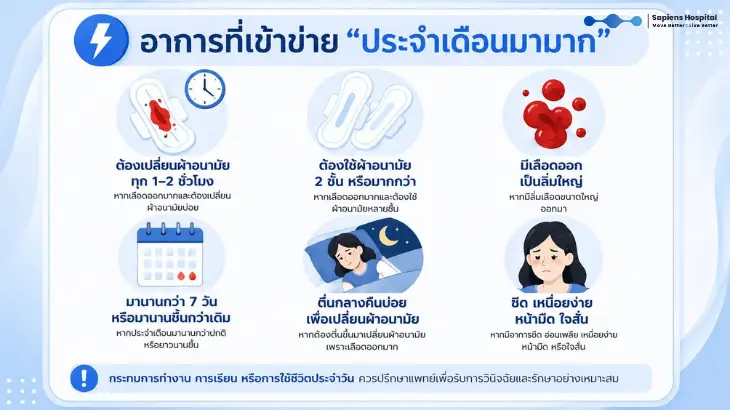
- Needing to change a sanitary pad or tampon very frequently, such as every 1–2 hours
- Needing double protection, such as using two sanitary products or combining daytime and nighttime protection
- Passing large blood clots
- Periods lasting noticeably longer than usual or more than about 7 days
- Bleeding heavily enough to interfere with work, school, or everyday activities
- Frequently waking during the night to change sanitary products
- Symptoms of anemia such as fatigue, dizziness, palpitations, or weakness
- Spotting or bleeding between periods
- Bleeding after sexual intercourse
- Bleeding after menopause
These symptoms do not necessarily mean that you have a serious disease, but they are reasons to investigate the cause. Avoid taking medications to stop bleeding or hormonal medications on your own without appropriate medical assessment.
What Can Cause Heavy Menstrual Bleeding?
In clinical practice, abnormal uterine bleeding is commonly evaluated using the FIGO “PALM-COEIN” classification system, which separates causes into structural abnormalities and non-structural causes. This approach helps doctors systematically investigate the cause rather than assuming that heavy bleeding is caused only by hormonal changes.
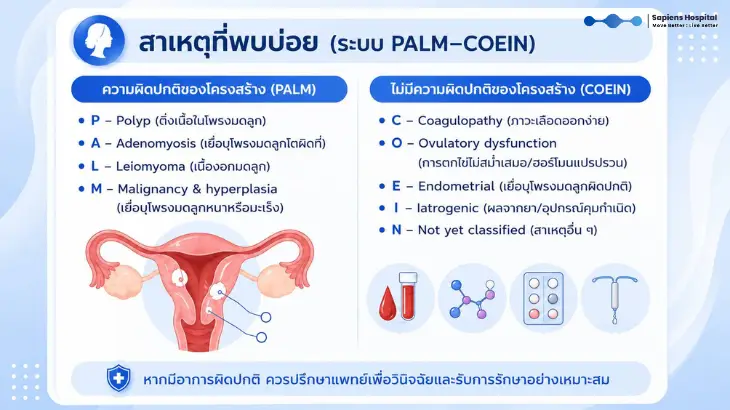
1. Endometrial Polyps
Polyps may cause spotting between periods, bleeding after sexual intercourse, or heavier-than-usual menstrual bleeding. Some polyps may not be clearly visible on a routine ultrasound, and additional evaluation of the uterine cavity may be required.
2. Adenomyosis
Adenomyosis commonly causes increasingly painful periods, enlargement of the uterus, and heavier or longer menstrual bleeding. It is often diagnosed in women aged 35–50 or those who have previously been pregnant, although it can occur at other ages as well.
3. Uterine Fibroids
Uterine fibroids, also called myomas or leiomyomas, are a common cause of heavy menstrual bleeding, particularly when a fibroid is located close to or protrudes into the uterine cavity. Patients may also experience lower abdominal pain, pelvic pressure, frequent urination, or a palpable lower abdominal mass.
4. Endometrial Hyperplasia or Endometrial Cancer
These conditions are less common than other causes in women of reproductive age but require greater attention in women aged 45 years or older, those with significant obesity, diabetes, polycystic ovary syndrome (PCOS), long-standing irregular or infrequent periods, or bleeding after menopause.
5. Bleeding Disorders
Some women have heavy menstrual bleeding from adolescence or other signs of easy bleeding, such as frequent nosebleeds, easy bruising, or prolonged bleeding after dental extraction. These symptoms may require evaluation for a blood disorder or clotting abnormality. This is particularly important in adolescents who have experienced heavy menstrual bleeding since menarche. ACOG recommends screening adolescents with heavy menstrual bleeding for bleeding disorders when the medical history suggests increased bleeding tendency.
6. Irregular Ovulation and Hormonal Fluctuations
Irregular ovulation may occur during the first years after menstruation begins, in women with PCOS, after rapid weight changes, during periods of stress or intense exercise, or during perimenopause. These changes can cause periods to become infrequent, frequent, or unusually heavy.
7. Certain Medications and Contraceptive Devices
Anticoagulants, certain hormonal medications, some forms of contraception, and copper intrauterine devices may increase menstrual bleeding or cause spotting. Tell your doctor about all medications and contraceptive methods you are currently using.
8. Pregnancy or Pregnancy-Related Complications
In women of reproductive age, pregnancy should always be considered when abnormal bleeding occurs, even when the patient believes pregnancy is unlikely. Bleeding may be associated with threatened miscarriage, incomplete miscarriage, or ectopic pregnancy, some of which require urgent medical assessment. Warning signs that require immediate hospital evaluation include:
- Bleeding heavily enough to require changing a sanitary pad every hour for several consecutive hours
- Dizziness, fainting, palpitations, severe fatigue, or weakness
- Unusually severe lower abdominal pain
- Possible pregnancy, or a missed period followed by bleeding
- Bleeding after menopause, or bleeding accompanied by fever, foul-smelling vaginal discharge, or lower abdominal pain
- Repeated bleeding after sexual intercourse
- A history of a bleeding disorder, use of anticoagulants, or difficulty stopping bleeding
- Severe anemia, shortness of breath, or chest pain
ACOG emphasizes assessment of hemodynamic stability in patients presenting with acute abnormal uterine bleeding. Patients with severe bleeding should receive prompt evaluation to control the bleeding and identify the underlying cause.
What Tests May Be Needed for Heavy Menstrual Bleeding?
Not everyone needs the same tests. Your doctor will select appropriate investigations based on your age, symptoms, risk factors, pregnancy history, and physical examination findings.
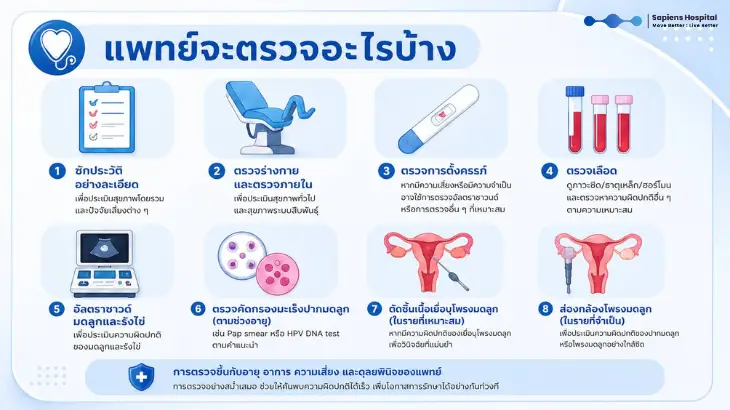
1. Detailed Medical History
Your doctor will ask about your menstrual cycle, amount and duration of bleeding, blood clots, pain, pregnancy history, contraception, medications, underlying diseases, family history, and symptoms of anemia or easy bleeding. These details are important because “heavy” can mean different things to different people. Explaining how often you change sanitary products, how many days the bleeding lasts, whether you pass clots, and how the bleeding affects your life helps your doctor assess the severity more accurately.
2. Physical and Pelvic Examination
Your doctor may examine your abdomen, look for signs of anemia, and perform a pelvic examination to assess the cervix, vagina, uterine size, pelvic masses, or other possible sources of bleeding. For patients who have never had sexual intercourse or are uncomfortable with a pelvic examination, the doctor will consider an appropriate alternative while respecting the patient’s privacy.
3. Pregnancy Test
For women of reproductive age, pregnancy testing is a basic investigation when abnormal bleeding occurs because it helps distinguish pregnancy-related conditions, such as miscarriage or ectopic pregnancy, from ordinary menstrual bleeding.
4. Blood Tests for Anemia and Iron Deficiency
If bleeding is heavy or prolonged, doctors commonly order a complete blood count (CBC) to check for anemia and may assess ferritin or iron status in selected patients. Chronic heavy menstrual bleeding can lead to iron deficiency even before obvious anemia develops.
5. Hormonal or Other Tests When Indicated
Some patients may require thyroid testing, assessment of hormones related to ovulation, or blood-clotting tests, particularly when abnormal menstrual cycles are accompanied by weight changes, acne, excessive hair growth, infrequent periods, or a history of easy bleeding.
6. Ultrasound of the Uterus and Ovaries
Ultrasound can evaluate uterine size, uterine fibroids, some types of polyps, the endometrium, ovarian abnormalities, and pelvic masses. AAFP notes that transvaginal ultrasonography is commonly used as first-line imaging in the evaluation of abnormal uterine bleeding in many patients.
7. Age-Appropriate Cervical Cancer Screening
If you have never undergone a Pap smear or HPV test, or if screening is due, your doctor may consider cervical cancer screening, particularly if you have bleeding after sexual intercourse or an abnormality of the cervix identified during pelvic examination.
8. Endometrial Biopsy
An endometrial biopsy may be necessary in certain patients, particularly women aged 45 years or older or women younger than 45 with risk factors such as significant obesity, PCOS, diabetes, exposure to estrogen without adequate progesterone, persistent bleeding, or bleeding that does not improve with medical treatment. ACOG and AAFP indicate that endometrial sampling is an important part of evaluating abnormal uterine bleeding in appropriate patients aged 45 years and older.
9. Hysteroscopy
If an endometrial polyp, a mass protruding into the uterine cavity, or another intrauterine abnormality is suspected—or if biopsy results do not explain persistent abnormal bleeding—the doctor may consider hysteroscopy. This allows direct visualization of the uterine cavity and, in some cases, treatment during the same procedure.
How Is Heavy Menstrual Bleeding Treated?
Treatment depends on the underlying cause, severity, age, desire for future pregnancy, associated medical conditions, and the patient’s preferences. Not everyone requires surgery, and the same medication is not appropriate for every patient.
1. Treating Anemia and Iron Deficiency
If anemia or iron deficiency is present, your doctor may recommend iron supplementation and monitor your blood levels. Even after bleeding is controlled, untreated iron deficiency may continue to cause fatigue, dizziness, palpitations, and reduced well-being.
2. Medications to Reduce Menstrual Bleeding
Certain medications, such as tranexamic acid or NSAIDs in appropriate cases, may reduce menstrual blood loss. They should be used according to medical indications and with consideration of contraindications and individual risks, including thromboembolic disease, kidney disease, gastrointestinal conditions, and interactions with other medications.
3. Hormonal Treatment
Hormonal treatments, such as combined hormonal contraceptives, progesterone/progestogen therapy, or a levonorgestrel-releasing intrauterine system, may help control bleeding in selected patients, particularly when bleeding is associated with irregular ovulation or when there are no contraindications to hormonal therapy.
4. Treating the Specific Cause
If bleeding is caused by an endometrial polyp, removal may be considered. Uterine fibroids may be treated with medication, procedures, or surgery depending on their type, size, and location. Suspected endometrial hyperplasia or other endometrial abnormalities should be treated according to biopsy findings. Patients with bleeding disorders may require coordinated care with a hematologist.
5. Procedures or Surgery
For patients with severe bleeding that does not respond to medication, structural abnormalities, or no desire for future pregnancy, procedures such as hysteroscopic polypectomy, myomectomy, endometrial ablation, or hysterectomy may be considered according to clinical indications and medical assessment. NICE recommends that assessment and treatment of heavy menstrual bleeding take into account the underlying cause and the patient’s preferences, with medical, procedural, and surgical options selected appropriately for each individual.
Heavy Menstrual Bleeding in Adolescents: What Should You Watch For?
Adolescents may have irregular menstrual cycles during the first few years after menstruation begins because the hormonal system is still maturing. However, if bleeding is heavy enough to cause anemia, frequent absence from school, or is accompanied by signs of easy bleeding—such as frequent nosebleeds, easy bruising, or prolonged bleeding after dental extraction—medical evaluation is recommended. ACOG recommends evaluating adolescents with heavy menstrual bleeding for anemia, iron deficiency, causes of ovulatory dysfunction, and possible bleeding disorders when the history is suggestive.
Heavy Menstrual Bleeding During Perimenopause Requires Greater Attention
From the 40s onward, menstrual cycles may begin to change because of irregular ovulation during perimenopause. However, heavy bleeding should not automatically be attributed to menopause. At this stage of life, endometrial abnormalities, polyps, uterine fibroids, and endometrial cancer require more careful consideration. If you are aged 45 years or older and experience abnormal bleeding, consult a gynecologist to determine whether endometrial evaluation or sampling is appropriate.
Bleeding After Menopause Should Not Be Watched and Waited On
If your periods have stopped because of menopause and you begin bleeding again, even if the amount is very small, you should see a doctor. Postmenopausal bleeding requires systematic evaluation of the endometrium and other possible causes. It does not necessarily mean cancer; it may result from tissue atrophy, polyps, hormone therapy, or other causes. However, important conditions should be excluded through appropriate medical evaluation.
How to Take Care of Yourself When You Have Heavy Menstrual Bleeding
If your periods are unusually heavy, start keeping a detailed menstrual record, including:
- When your period starts and ends
- Which days have the heaviest bleeding
- How many times you change sanitary products each day
- Whether you pass blood clots
- How severe your abdominal cramps are
- Whether you have bleeding between periods
- Whether you experience anemia-related symptoms such as fatigue, palpitations, or dizziness
- Whether the bleeding affects work, school, or sleep. This information helps your doctor assess the condition more accurately than simply saying that your period is “heavy,” because it shows the pattern and severity of bleeding more clearly.
Do not self-medicate with hormonal medications, medications intended to stop bleeding, or herbal remedies. These may mask symptoms, delay diagnosis, or cause adverse effects in people with contraindications.
Frequently Asked Questions
1. What causes heavy menstrual bleeding?
Heavy menstrual bleeding can have many causes, including hormonal fluctuations, irregular ovulation, uterine fibroids, endometrial polyps, endometrial thickening, bleeding disorders, certain medications, or pregnancy-related complications. If the problem recurs or affects your daily life, the underlying cause should be evaluated.
2. Are blood clots during menstruation dangerous?
Blood clots may occur on heavier menstrual days. However, if the clots are large or frequent, the bleeding is heavy enough to require very frequent sanitary-product changes, or you have symptoms such as fatigue, anemia, or dizziness, you should see a doctor.
3. What should I do if heavy periods cause anemia?
See a doctor for blood tests to evaluate anemia and iron status and to determine the cause of the bleeding. If you have severe anemia or symptoms such as dizziness, palpitations, or significant shortness of breath or fatigue, seek prompt medical attention.
4. Does everyone with heavy menstrual bleeding need a uterine ultrasound?
No. Ultrasound is not necessary for every patient, but it may be considered for recurrent abnormal bleeding, lower abdominal pain, a palpable mass, suspected uterine fibroids or polyps, or symptoms that do not improve with initial treatment. Transvaginal ultrasound is commonly used to evaluate abnormal uterine bleeding.
5. If I am 45 or older and have heavy periods, do I need an endometrial biopsy?
Several guidelines recommend considering endometrial sampling in patients aged 45 years or older who have abnormal uterine bleeding because age is one of the risk factors for endometrial abnormalities. Your doctor will evaluate this together with your symptoms and other risk factors.
6. Does heavy menstrual bleeding require surgery?
Not necessarily. Treatment options range from iron supplementation, medications to reduce bleeding, hormonal therapy, and hormonal intrauterine systems to procedures or surgery in selected patients. The appropriate treatment depends on the cause, severity, and desire for future pregnancy.
7. What should I do if I bleed after menopause?
See a doctor. Postmenopausal bleeding should not simply be observed at home because the cause needs to be investigated, including appropriate evaluation of the endometrium.
Heavy menstrual bleeding should not be ignored, particularly when you need to change sanitary products very frequently, pass blood clots, bleed for many days, experience bleeding between periods or after sexual intercourse, or develop symptoms such as fatigue, dizziness, or palpitations.
The cause may simply be hormonal fluctuations during certain stages of life, but heavy bleeding may also result from uterine fibroids, polyps, endometrial abnormalities, bleeding disorders, medication effects, or conditions requiring specific treatment. Appropriate evaluation may include a detailed medical history, pelvic examination, blood tests, pregnancy testing, ultrasound, cervical cancer screening, and, in selected patients, endometrial biopsy.
Most importantly, do not allow unusually heavy periods to become accepted as a normal part of your life. Your body may be signaling that something requires attention. Earlier assessment can help identify the cause and allow appropriate treatment so you can return to daily life with greater confidence.
For information and appointments
Sapiens Hospital Move Better : Live Better
Tel. 02-111-3703
References
1. National Institute for Health and Care Excellence. Heavy menstrual bleeding: assessment and management. NICE Guideline NG88.Published 2018, updated 2021; reviewed 2024.
2. American College of Obstetricians and Gynecologists. Diagnosis of Abnormal Uterine Bleeding in Reproductive-Aged Women. ACOG Practice Bulletin.
3. American College of Obstetricians and Gynecologists.Management of Acute Abnormal Uterine Bleeding in Nonpregnant Reproductive-Aged Women. Committee Opinion No. 557. Obstetrics & Gynecology.2013.
4. Munro MG, Critchley HOD, Fraser IS; FIGO Menstrual Disorders Committee. The two FIGO systems for normal and abnormal uterine bleeding symptoms and classification of causes of abnormal uterine bleeding in the reproductive years: 2018 revisions. International Journal of Gynecology & Obstetrics. 2018;143(3):393–408.
5. Wouk N, Helton M. Abnormal Uterine Bleeding in Premenopausal Women.American Family Physician. 2019;99(7):435–443.
6. Williams PM, Gaddey HL.Endometrial Biopsy: Tips and Pitfalls. American Family Physician. 2020;101(9):551–556.
7. American College of Obstetricians and Gynecologists. Screening and Management of Bleeding Disorders in Adolescents With Heavy Menstrual Bleeding. Committee Opinion. 2019.