

My Child Is a Picky Eater, Growing Slowly, and Not Gaining Weight — What Tests Are Needed?
When parents notice that their child eats less than other children, is not gaining much weight, can wear the same clothing size for a long time, or is often described by relatives as being small, many concerns naturally arise: “Is my child malnourished?” “Do they need a blood test?” “Could there be an underlying disease?” or “Are they simply a picky eater who will eventually grow out of it?”
There is no single answer that applies to every child. Some children eat relatively little but continue to grow normally along their growth curve, remain active, and have no underlying illness. Others may have feeding difficulties together with falling weight percentiles, slow growth, anemia, easy fatigue, chronic diarrhea, or frequent illness. These children should receive a thorough medical assessment. The most important point is not to judge a child’s growth from a single weight measurement or by comparing them with other children. Instead, look at “the individual child’s growth trend” over time on an appropriate growth chart.
The NICE guideline uses the term faltering growth to describe children whose growth pattern is lower than expected. Assessment considers changes across weight centiles together with age, birth weight, height, BMI, and the child’s overall condition rather than relying on a single weight measurement. The MSD Manual also recommends assessing weight, height or length, and head circumference for age using growth charts such as WHO or CDC growth charts, together with dietary history, family history, and a detailed physical examination.
Start With the Growth Chart, Not With Blood Tests
Being small does not necessarily mean that something is wrong. Some children are naturally small from birth, have smaller parents, and continue to grow steadily along their own growth curve. This may represent familial small stature rather than malnutrition. However, if a child’s weight was previously tracking along one percentile and then gradually crosses downward through several percentile lines, or if height growth also begins to slow, doctors will pay closer attention. Weight often changes first when a child is not receiving enough energy, while slowing height growth may suggest a more prolonged or significant problem.
For young children, the World Health Organization provides the WHO Child Growth Standards, developed from data involving 8,440 healthy children from several countries. These standards are widely used for assessing growth in children younger than 5 years. For older children, age- and sex-appropriate charts for height, weight, and BMI are generally used to assess trends rather than isolated measurements.
Therefore, the first assessment should include accurate measurement of weight and height, as well as head circumference in young children, followed by plotting current and previous measurements on the appropriate growth chart. If you have your child’s vaccination record, child health booklet, or previous weight records, bring them to the appointment. Historical growth data can often provide more useful information than ordering a large panel of blood tests at the first visit.
When Is Picky Eating Still Manageable, and When Should It Be Investigated?
Many toddlers and preschool-aged children go through periods of selective eating, eating slowly, becoming easily bored with food, or being more interested in playing than eating. If the child remains energetic, plays normally, sleeps well, has no anemia, diarrhea, or vomiting, and weight and height continue to follow their established growth curves, the problem may be age-related picky eating or a family feeding pattern that can be adjusted rather than a serious illness.
However, if the child consistently eats very little, does not gain weight for several months, crosses downward on the growth chart, has slowing height growth, anemia, easy fatigue, or frequent illnesses, or has chronic diarrhea or vomiting, greasy or unusually foul-smelling stools, blood in the stool, chronic abdominal pain, difficulty swallowing, frequent choking, or coughing during feeding, developmental delay, or severe feeding behaviors such as fear of certain food textures, holding food in the mouth for a very long time, or crying at every meal, the child should be medically evaluated in a systematic manner.
Royal Children’s Hospital Melbourne notes that slow weight gain often involves multiple contributing factors. In children younger than 2 years, nutrition is particularly important for growth. Many cases are related to inadequate energy intake, although chronic disease, recurrent infections, family factors, feeding practices, and dietary restrictions should also be considered.
Main Causes of Poor Weight Gain in Children
The most common cause is inadequate energy intake. A child may eat only small amounts, have irregular mealtimes, drink so much milk that they are not hungry for meals, consume mainly sweet drinks or snacks, require constant feeding by caregivers and therefore have difficulty learning their own hunger and fullness cues, or have problems with food textures, such as accepting only liquids and refusing to chew more textured foods.
Another group of causes involves poor absorption or loss of nutrients. Examples include chronic diarrhea, some forms of cow’s milk protein allergy, celiac disease in children who consume gluten and have compatible symptoms, inflammatory bowel disease, parasitic infection, and certain pancreatic or gastrointestinal disorders. These conditions are often accompanied by gastrointestinal symptoms such as frequent loose stools, abdominal pain, bloating, greasy or strong-smelling stools, poor weight gain despite apparently adequate intake, or blood in the stool.
Another possibility is that the body is using more energy than usual. This may occur with heart disease, chronic lung disease, poorly controlled asthma, hyperthyroidism, chronic infections, kidney disease, liver disease, chronic inflammatory conditions, or, less commonly, certain cancers that should not be overlooked when clinically suspected. Developmental, neurological, muscular, swallowing, and family-environment factors can also affect feeding. NICE recommends that assessment of faltering growth consider clinical, developmental, social, and feeding history, and that direct observation of feeding or mealtimes may be useful when necessary.
What Tests May Be Needed?
The most important assessment at the first visit is a detailed medical history and physical examination. The doctor may ask about pregnancy, birth weight, delivery, breastfeeding or formula feeding, formula preparation, the actual amount of food consumed each day, food textures the child can tolerate, meal schedules, who feeds the child, how independently the child can eat, whether food is forced or used as a distraction, whether screens are used during meals, as well as vomiting, diarrhea, fever, recurrent illness, sleep, development, medications, underlying conditions, and the parents’ body size.
NICE recommends that parents keep a record of food intake and mealtime behavior, including the type and amount of food, timing, location, and any difficulties during feeding. This gives doctors a more accurate picture of the child’s eating pattern rather than relying only on the statement that the child “doesn’t eat much.”
The physical examination involves more than weighing the child. The doctor may assess height, body proportions, head circumference in younger children, signs of malnutrition, anemia, skin, hair, nails, mouth, teeth, abdomen, liver and spleen, heart, lungs, muscles, development, and signs of chronic disease. A careful physical examination often helps determine which investigations are appropriate rather than ordering every possible test without a specific clinical reason.
For children with slow weight gain and appropriate clinical indications, the doctor may consider urinalysis and urine culture, particularly in younger children because urinary tract infections can sometimes present mainly as poor weight gain. Basic blood tests may include a complete blood count (CBC/FBE), ferritin to assess anemia or iron deficiency, electrolytes and kidney function, glucose, liver function tests, thyroid testing such as TSH, and, in children who consume gluten and have compatible symptoms, celiac serology together with total IgA. Royal Children’s Hospital Melbourne lists investigations that may be considered in children with slow weight gain, including urine analysis and culture, FBE, ferritin, UEC, TSH, glucose, LFT, coeliac serology with total IgA when appropriate, as well as selected stool investigations and ESR or
faecal calprotectin in older children when clinically indicated.
However, blood tests are not the first answer for every child. The AAP indicates that imaging or laboratory investigations should be guided by specific clinical findings or considered when faltering weight persists despite appropriate management, rather than routinely ordering broad testing at the outset. NICE similarly notes that in otherwise well children without additional clinical symptoms, investigations beyond the initial assessment are relatively unlikely to identify an underlying disorder.
When Should Stool or Gastrointestinal Tests Be Considered?
If poor weight gain occurs together with chronic diarrhea, greasy or unusually foul-smelling stools, marked abdominal bloating, chronic abdominal pain, frequent vomiting, blood or mucus in the stool, or if the child eats well but still fails to grow, doctors may consider malabsorption or intestinal inflammation. Stool tests may help evaluate infection, parasites, fat in the stool, or signs of intestinal inflammation. Testing for celiac disease may be considered in children with compatible symptoms who are consuming gluten.
For children with significant symptoms or those who do not improve after appropriate nutritional intervention, referral to a pediatric gastroenterologist may be considered for additional investigations such as ultrasound, endoscopy, or other specialized tests. Endoscopy should not be the starting point for every child. The AAP notes that endoscopy may be considered when weight continues to falter despite appropriate management or when a diagnosis cannot otherwise be established without direct evaluation of the gastrointestinal tract.
When Should Hormones or Height Growth Be Investigated?
If the main problem is “poor weight gain” while height continues to follow the previous growth curve, assessment often begins with calorie intake and feeding. However, if height growth also slows, the child becomes increasingly short for age, bone age is delayed, puberty is delayed, or body proportions are abnormal, further evaluation of growth and hormonal causes may be appropriate.
NICE recommends assessing BMI centile when there is concern about linear growth in children older than 2 years. If height growth is slow or short stature cannot be adequately explained, consultation with or referral to a specialist pediatric service should be considered.
Why Doesn’t the Doctor Order Many Blood Tests Immediately?
Many parents feel reassured by blood testing, but extensive testing at the beginning may not help identify the cause in a child with picky eating and poor weight gain when the history and examination do not suggest a particular disease. Keeping an accurate 3-day food diary, observing mealtimes, increasing dietary energy appropriately, and monitoring weight at suitable intervals may provide more useful information.
NICE recommends having a clear management plan, including how food intake will be adjusted, when weight will be reviewed, how the child will be reassessed, and when further testing or referral should be considered. Weighing a child too frequently may unnecessarily increase parental anxiety, so follow-up intervals should be appropriate for the child’s age and level of clinical concern.
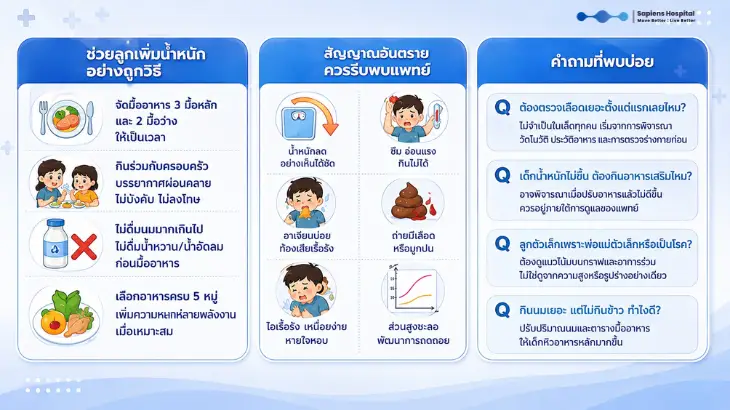
Initial Care Before and While Waiting to See a Doctor
One of the most useful things parents can do is keep an accurate 3-day food diary. Record the actual time of meals, types of food, approximate amounts, milk, water, sweetened drinks, and snacks, as well as symptoms during feeding, how long each meal lasts, and the frequency of bowel movements or vomiting. This record can reveal overlooked problems such as drinking too much milk and therefore not being hungry for meals, frequent snacking that reduces appetite for main meals, excessively long mealtimes, or total daily energy intake that is lower than expected.
NICE recommends maintaining a relaxed mealtime environment, allowing children to eat with the family, establishing regular meal schedules such as three main meals and two snacks, avoiding force-feeding or punishment during meals, and choosing age-appropriate amounts, types, and textures of food. If necessary, the energy density of foods may be increased temporarily, or the child may be referred to a pediatric dietitian.
Another commonly overlooked issue is excessive milk intake. Some children drink milk throughout the day and therefore are not hungry for meals. Although milk is nutritious, excessive intake can reduce appetite for other foods. NICE notes that excessive intake of energy-dense drinks, including milk, can reduce appetite for other foods in children with faltering growth.
Warning Signs That Should Prompt Medical Assessment
If a child is actually losing weight rather than simply not gaining, earlier assessment is advisable because weight loss beyond the newborn period is not generally expected in the same way it may occur in adults. Seek medical assessment promptly if the child is lethargic, weak, unable to eat, has significant vomiting, chronic diarrhea, blood in the stool, persistent fever, chronic cough, night sweats, shortness of breath, easy fatigue, abnormal urination, swelling, marked pallor, recurrent infections, developmental regression, or clearly slowing height growth.
NICE recommends pediatric consultation or referral when there are symptoms or signs suggesting an underlying disorder, lack of response to primary care interventions, unexplained slow linear growth or short stature, rapid weight loss, severe malnutrition, or concerns about the child’s safety and care.
Frequently Asked Questions from Parents
- My child eats very little but still plays normally. Do they need a blood test?
If weight and height continue to follow the established growth curves, development is normal, and there is no diarrhea, vomiting, persistent fever, anemia, or frequent illness, blood tests may not be immediately necessary. Doctors often begin by reviewing the growth chart, dietary history, and mealtime behavior. If weight crosses downward through percentile lines or other abnormal symptoms are present, investigations can then be selected according to the suspected cause. - My child drinks a lot of milk but does not eat meals. What should I do?
A doctor or pediatric dietitian can help assess the appropriate amount of milk for the child’s age. Excessive milk intake may make a child too full to eat other foods and may reduce dietary variety. Adjusting the milk and meal schedule can help the child experience appropriate hunger before main meals. - If my child is not gaining weight, do they need nutritional supplements?
Oral nutritional supplements should not automatically be started without first assessing the cause. Some children need only an adjustment in the energy content of regular foods, while others may have an underlying disease that requires treatment or swallowing and feeding-behavior problems requiring multidisciplinary support. NICE recommends considering liquid oral nutritional supplements for children with persistent faltering growth after dietary and initial management measures, with ongoing monitoring of weight, height, other food intake, acceptance, and continued need for supplementation. - Is my child small because the parents are small, or could it be a disease?
The answer depends on the child’s growth trend and expected height based on parental height. A child who is small but grows consistently, remains active, eats adequately, and has no other symptoms may have a constitutional or familial small build. However, if weight crosses downward through growth percentiles, height growth slows, or symptoms such as anemia, chronic diarrhea, easy fatigue, or frequent illness are present, further evaluation is needed.
Picky eating, slow growth, and poor weight gain should not be judged only by impression or by comparing a child with other children. The appropriate starting point is to accurately measure weight, height, and head circumference when appropriate, and plot these measurements on a growth chart to assess the trend. If the child continues to grow along the established curve, the focus may be on improving feeding behavior and monitoring. If weight crosses downward through percentiles, height growth slows, or other symptoms are present, the cause should be investigated systematically.
Good medical assessment does not mean testing everything at once. It means selecting investigations based on the child’s history and symptoms. Some children may need blood, urine, or stool tests. Others may require evaluation for swallowing difficulties, allergies, gastrointestinal disease, hormonal disorders, or chronic illnesses. Many children, however, primarily need appropriate adjustments to meal patterns, dietary energy, milk schedules, and the mealtime environment.
If parents notice that their child has significant feeding difficulties, has not gained weight for several months, or is becoming smaller relative to their previous growth curve, early medical assessment can help distinguish between a feeding behavior problem that can be modified and an underlying condition that requires treatment. A child’s growth is not simply a number on the scale; it is an important indicator of health, energy, development, and long-term quality
of life.
If your child has weight loss, lethargy, inability to eat, chronic vomiting or diarrhea, blood in the stool, persistent fever, easy fatigue, marked pallor, frequent illness, developmental delay, or clearly slowing height growth, seek medical assessment promptly.
Sapiens Hospital
Move Better:Live Better
Tel. 02-111-3703
References
National Institute for Health and Care Excellence. Faltering growth: recognition and management of faltering growth in children. NICE Guideline NG75.
Royal Children’s Hospital Melbourne. Clinical Practice Guidelines: Slow weight gain.
World Health Organization. WHO Child Growth Standards: methods and development.
MSD Manual Professional Edition. Growth and Weight Faltering in Children.
American Academy of Pediatrics. Guidance on faltering weight in children.